


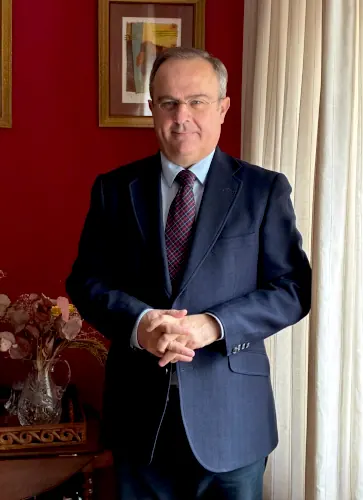
Dr Javier Junceda
Javier Junceda, a renowned jurist, former Dean of the Faculty of Law at the International University of Catalonia and a Numerary Member-elect of the Royal European Academy of Doctors (READ), reflects on the daily workings of the judiciary and the role of research and science in Spain in the articles “Anomic Practicalities,” “Scientists” and “Reading,” published between 17 January and 27 February in the specialised portal Confilegal and the digital newspaper El Debate. In addition, the Asturian newspaper “La Nueva España” reported on 24 February that the distinguished jurist will teach a course within the specialised programme in Administrative Law and Public Administration at the Faculty of Law of the University of Buenos Aires, following his initiative to promote the new Hispano-American Legal Studies Area.
In “Anomic Practicalities,” the academic refers to decisions made in judicial offices on procedural matters that are resolved according to the personal criteria of the officials on duty or to customary practices within judicial bodies that are not necessarily grounded in formal rules or jurisprudential standards. “Although there are officials responsible for ensuring the legal regularity of proceedings, it is not unusual for certain details to remain at the discretion of other judicial employees, who then rely on their own judgement or on what has traditionally been done in their workplace—often without knowing why—when dealing with certain controversial issues. There is no doubt that these ‘pragmatic’ criteria do not usually extend to key aspects, but neither can it be ruled out that they might,” he explains.
In “Scientists,” he addresses the Global Innovation Index, which ranks countries by their levels of knowledge, creativity, and technological development. “Scientific work, without tangible and measurable results, is little more than an intellectual diversion. In fact, the dictionary defines science as the body of knowledge obtained through observation and reasoning, from which principles can be deduced, verified or predicted in practice. Without that objective, I doubt that science can truly deserve that name, however much those who spend their lives dealing with inconsequential matters at the expense of public budgets insist otherwise,” he argues.
Finally, in “Reading,” Junceda discusses the decline in reading rates, a reality he views as closely linked to the parallel weakening of critical thinking. “The most disturbing aspect of this rapid decline in reading habits is its connection with the parallel weakening of critical thinking. The objective analysis and questioning of available information become unthinkable in such an environment, opening the door wide to superficial perceptions driven by simple external biases, in which logic, calm reflection, the search for truth, rational doubt, evidence, or the different perspectives that any subject may admit never find space. This sad scenario is the one in which we move today,” he notes.

Founder and director of Junceda Abogados, the academic is a full member of the Royal Institute of Asturian Studies, where he chairs the Commission on Law, Social and Economic Sciences, and a Numerary Member of the Asturian Royal Academy of Jurisprudence. He is also a Corresponding Member of the Royal Academy of Jurisprudence and Legislation of Spain and of the North American Academy of the Spanish Language, as well as an Honorary Member of the Peruvian Academy of Law. He serves on the Barcelona Arbitration Tribunal, the Arbitration Court of the European Arbitration Association in Madrid, and the Arbitration Tribunal of the Pontifical Catholic University of Peru. Since 2016, he has been a member of the Commission on Urban Planning and Territorial Planning of the Principality of Asturias, appointed among experts of recognised prestige, and a member of the Advisory Council of the Spanish Association of Urban Planning Law.
He has served as an expert on 18 parliamentary committees on legislative reforms and has drafted several legislative bills, proposals, and regulatory provisions. He is the author or co-author of more than 200 legal works, some of which have served as a basis for judicial decisions in the Constitutional Court of Chile, the Supreme Court of Peru, and courts in Bolivia. He has received mentions in the Luis Sela Sampil Awards for doctrinal articles from the Faculty of Law of the University of Oviedo, and twice in the prestigious Financial Studies Award (1992 and 2012), organised by the Centre for Financial Studies of Madrid. He is also a member of the editorial boards of fourteen Spanish and international legal journals. He has been awarded honorary doctorates by six foreign universities and honorary professorships by another six. In addition, he has served as a director, speaker, or lecturer in more than 50 training programmes held in Spain and Ibero-America. He is also the creator and driving force behind the Hispano-American Legal Studies Area, a forum for dialogue and debate between Spanish and Ibero-American jurists on current issues in the legal profession.