

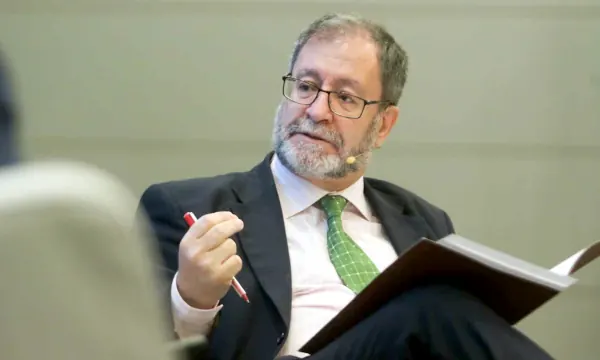
Dr. Francisco López Muñoz
Francisco López Muñoz, Professor of Pharmacology and Vice-Rector for Research, Science and Doctoral Studies at Camilo José Cela University, corresponding member of the Royal Academy of Medicine of the Basque Country and other national and international academies, and full member of the Royal European Academy of Doctors (RAED), reconstructs, on the basis of diaries, memoirs and post-war testimonies, what the doctors and medical personnel of the Blue Division saw and understood about the persecution of Jews on the Eastern Front in the article “Spanish Doctors of the Blue Division and the Holocaust”, published in the latest issue of the “Annals of the Royal Academy of Doctors of Spain”, volume 11, number 2, 2026. The academic co-authored the study with Esther Cuerda, lecturer in the Department of History, Philosophy and Ethics of Medicine at Heinrich Heine University Düsseldorf, Germany.
The two experts explain that between 1941 and 1943, around 208 medical officers, some forty physicians who were not members of the Military Medical Corps, 16 pharmacists and nearly 150 nurses served in the Spanish Volunteer Division, incorporated into the Wehrmacht as the 250th Infantry Division. They treated combat wounds, frostbite, infections and infectious diseases at first-aid posts, field hospitals and evacuation centres in Vilnius, Riga and Königsberg. At the front, especially on the Volkhov and later on the southern flank of the siege of Leningrad, contact with the Jewish population was already impossible: that community had been annihilated before the Spaniards arrived. Encounters occurred in the rear and during transit eastwards.
In August 1941, while crossing Grodno, members of the division saw Jewish neighbourhoods, Star of David armbands and groups led by Germans to rubble-clearing work. Doctor José Luis Cáceres García de Viedma recorded it in his diary in an almost tourist-like tone: “the Hebrew women attracted attention because of their abundance and, above all, their beauty”. He did not mention the massacres carried out by Einsatzgruppe B in July, nor the two ghettos that would be sealed in November. In Vilnius, whose outskirts he passed on 8 September, thousands of civilians had just been executed in the Ponary forest. The Spanish hospital was established there months later, in February 1942, in a former railway workers’ residence five kilometres from the city centre. In Riga, the former Deutsche Krankenhaus building became an evacuation hospital immediately after the Rumbula massacre, where 30,000 Jews were shot.
Inside those hospitals, coexistence was different. The medical service employed Jewish auxiliary staff and interpreters under conditions comparable to those of Spaniards, Poles, Germans or Baltic personnel. Some soldiers escorted these workers when they travelled to and from the ghetto. Outside, medical personnel perceived discrimination and abuse by both Germans and local militias. According to later oral testimonies, they knew that something serious was happening to those confined there. There is no evidence, however, that they knew about the design of the so-called Final Solution or the operation of the gas chambers. Like much of the German civilian population, they saw the mistreatment but not the industrial plan of extermination.
 The authors emphasise a fundamental difference from other Axis allies. Spanish troops did not carry out systematic killings of Jews, unlike Romanian, Hungarian or Ukrainian units. Nor were they eyewitnesses to executions by the Einsatzgruppen, although they coincided in time and place during the advance. The antisemitism they brought with them, Cuerda and López Muñoz argue, was ideological rather than racial, characteristic of Spain at the time: without Nazi biological hatred and, in practice, without operational hostility. They were not perpetrators. Acts of protection, by contrast, were limited and not particularly forceful when compared with those of Italian soldiers or with the diplomatic action of figures such as Ángel Sanz Briz in Budapest. In rear-area hospitals there were, however, occasional and effective measures in favour of collaborating Jewish staff.
A recognised populariser of contemporary history, Spanish Golden Age literature, medicine and pharmacology, López Muñoz holds doctorates in Medicine and Surgery and in Spanish Language and Literature, is a specialist in Pharmaceutical Medicine and holds a diploma in Holocaust Studies from the International School for Holocaust Studies at Yad Vashem, Jerusalem. He is a researcher at the 12 de Octubre Hospital Research Institute in Madrid, a member of the Governing Council of the HM Hospitales Health Research Institute and of the Miguel de Cervantes Institute for Medieval and Golden Age Studies at the University of Alcalá de Henares, a member of the Science and Technology Council of the Community of Madrid, scientific adviser to the Ibero-American Committee on Ethics and Bioethics, a member of the Observation Committee of the Human Rights Observatory of Spain, of the Spanish Chapter of the Club of Rome and an honorary member of the Gandhi-Mandela Foundation.
He has taken part in numerous research projects and is the author of monographs and articles in his fields of study. He was recently appointed an honorary Kentucky Colonel and Honorary Civil Guard, coinciding with the 25th anniversary of the creation of this distinction, the force’s highest civilian honour, which is awarded exceptionally, and on 20 March he was awarded the Medal of Merit in Cyber Defence by the Professional Association of New Technology Experts.