

Sònia Fernández Vidal, renowned science communicator and Numerary Member of the Royal European Academy of Doctors (READ), presented the exhibition “Quantum Revolution” on 6 May, organised by the Telefónica Foundation under her curatorship and open to visitors free of charge until next October at the Foundation’s Madrid headquarters. With more than 120 works ranging from historic scientific pieces to contemporary creations, the exhibition invites visitors to explore what is considered the most astonishing and productive scientific theory of the last hundred years.
Through a pioneering dialogue between science and art, the exhibition reveals how human beings have moved from assuming a mechanical and predictable universe to one in which uncertainty and entanglement shape our technological present. Among the material on display are 17th-century bibliographic treasures by Galileo Galilei, alongside immersive installations, virtual reality and interactive developments designed to explain the revolution through multiple languages.
The structure of the exhibition makes it possible to understand the evolution of scientific thought through five thematic sections, beginning with a review of the classical physics of Isaac Newton and James Clerk Maxwell, where the world functioned as a machine governed by precise laws, up to the moment when Max Planck, Albert Einstein and Niels Bohr discovered that energy is exchanged in quanta. They were the precursors to the birth of quantum mechanics, the third section of the exhibition, which traces the development of the new theory through physicists such as Werner Heisenberg, Erwin Schrödinger, and Paul Dirac, who introduced the concepts of superposition and entanglement. From there, the exhibition raises the debate on whether there is an objective world independent of the observer, illustrated with works by artists such as Superflux and the studio fuse*, before concluding with the real impact that quantum physics has on the present and the future, through technologies such as the laser and the microchip, as well as quantum computing and telecommunications.
As a result of this exhibition, the digital magazine ComputerWorld published an interview with Fernández Vidal on 7 May, in which the expert highlights the already tangible advances of the so-called second quantum revolution in fields such as high-precision sensors and metrology, with applications in geological exploration and early cancer detection, secure quantum communications and post-quantum cryptography. In this regard, she explained how major financial institutions and leading companies are already preparing for what has come to be known as “Q-day”, the moment when a sufficiently powerful quantum computer could break current encryption systems.
The academic, however, believes that quantum computers will not replace classical ones, but will coexist with them in a hybrid model. While classical systems will remain more efficient for most everyday tasks, quantum systems will be ideal for solving specific, extremely complex problems, such as simulating materials at the atomic scale, advanced optimisation, or certain cryptographic calculations. She also warns of the strategic and ethical implications of this technology, since whoever first achieves an operational quantum computer will gain an enormous advantage in multiple fields, from medicine to national security. For this reason, she emphasises the importance of science communication and education so that society and policymakers can make informed decisions and prevent unethical uses of this tool, which she describes as a useful servant but a dangerous master.
Fernández Vidal has also just published the second part of “The Origin of ‘The Door of the Three Locks’: The Shadow of the Two Suns”, which completes the prequel to her successful trilogy “The Door of the Three Locks”, following the publication, at the end of 2024, of the first instalment, “The Origin of ‘The Door of the Three Locks’: The Seed of a Revolution”. This is a new science outreach series aimed at young readers, exploring the history of physics and its evolution towards quantum physics.
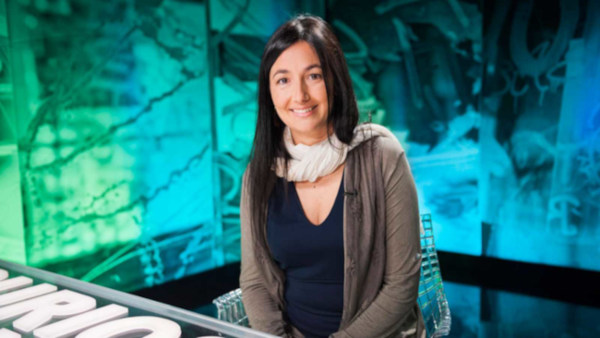
Dra. Sònia Fernández Vidal
For the academic, quantum physics is an anti-intuitive discipline that challenges everyday logic, making it more difficult to access but, at the same time, far more fascinating. Because it can seem like science fiction, its phenomena require creativity and curiosity. This is why the expert found in this field fertile ground for imagination, fascination and dissemination, in her case with children as the protagonists. As she herself explains, in her talks and books, she seeks to inspire both children and adults to enter the quantum world, appealing to those who would not normally be interested in a scientific essay and, at the same time, combating prevailing misinformation.
PhD in Optics, Quantum Information, and Physics from the Autonomous University of Barcelona, Fernández Vidal was selected by “Forbes” magazine as one of the 100 most creative people in the world. She has worked and collaborated as a researcher at some of the most prestigious centres, including the European Organization for Nuclear Research (CERN), the Los Alamos National Laboratory in the United States and the Institute of Photonic Sciences (ICFO) in Barcelona. In addition to the celebrated youth science outreach trilogy “The Door of the Three Locks”, she is also the author of “Quantic Love”, a novel set at CERN that brings science closer from its most human side. Her book “Breakfast with Particles” is a work of quantum physics outreach intended for general audiences, while “The Universe in Your Hands”, her previous outreach work aimed at younger readers, introduces children to the mysteries of the universe.