


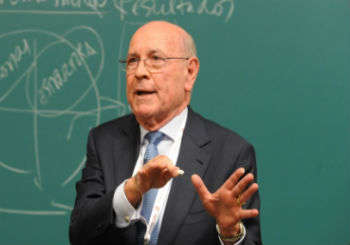
Jaume Llopis, emeritus professor at IESE Business School and Numerary Member and Vice-President of the Board of Governors of the Royal European Academy of Doctors (READ), shares with the academic community the article “The Budget Trap,” in which he examines the limitations that the annual budgeting process imposes on business management, as companies focus their efforts on balancing the accounts and preparing projections for the following fiscal year, often relegating—or even neglecting—day-to-day management. Llopis has developed a long and successful career in business management at companies such as Moulinex, Nestlé, La Unión y el Fénix Español, and Borges International Group. Alongside his extensive academic career and teaching at IESE, he has served as a visiting professor at business schools including IPADE (Mexico), AESE (Portugal), IDE (Ecuador), INCAE (Nicaragua), IEEM (Uruguay), MDE (Ivory Coast), Instituto San Telmo (Seville), and EADA (Barcelona). He is the author of several benchmark books in the field of business management.
The Budget Trap
At the end of the year, most companies are working on the budget for 2026, devoting many meetings and hours of work that are, to a large extent, unproductive. Large companies, with slower processes—especially multinationals—spend weeks or even months on this task, involving many people and departments.
Too many time and human resources should not be devoted to budgeting, because it can become a harmful and counterproductive tool for companies. If it is overly conservative, it leads to complacency and turns variable compensation linked to budget targets, if any, into something that is not motivating at all, but rather perceived as a fixed part of the salary. Not long ago, an executive told me he had met the budget for eighteen consecutive years. A bad sign, as it shows that objectives have not been sufficiently ambitious or challenging. You cannot win the league eighteen years in a row!
Jack Welch, former CEO of General Electric—the most admired executive of the twentieth century—who achieved an average annual total shareholder return of 23% over 20 years, was particularly critical of budgets. He said that being overly strict about meeting the annual budget makes no sense. One should aim to achieve the highest possible goals rather than adhere rigidly to what the budget dictates. «Not growing above 10% a year is for bureaucrats.»
Budget preparation entails a great deal of bureaucracy and sterile discussions that slow down corporate growth. Indeed, the process typically starts top-down, with senior management indicating the objectives the company as a whole seeks to achieve; then it moves bottom-up, with input from managers at lower levels—usually with reductions, logically, to protect themselves—and then back again from top to bottom and bottom to top. Let us not forget that if, moreover, the top executive is financially incentivized by meeting annual targets, some reserves will already have been set aside, just in case. The process continues and, in the end, a budget is approved that is relatively easy to meet and lacking in ambition.
 Another very conservative—and above all mistaken—approach is to start from the previous year’s figures and then add inflation, cost increases, and overhead growth. A serious mistake! One should always start from a zero-based budget, that is, question each and every euro from the previous year. Often, due to inertia, expense items that are no longer strictly necessary for the future are perpetuated, as they add nothing to the company. Is there not a great deal of unnecessary waste in Christmas gifts, travel, business lunches, or mobile phones?
Another common mistake is to prepare the budget at this time of year and then not review it throughout the following year. In a dynamic and changing market like today’s, the assumptions on which the calculations were based may change—and in fact do change—over periods shorter than a year. Consider interest rates and bank financing, oil prices, raw material prices, competitors’ moves, customer demands, armed conflicts… Well-managed companies review assumptions and, therefore, the budget every quarter, adjusting figures to changes in the environment so that they are always working with realistic scenarios.
Finally, my most vehement criticism is that the budget becomes a straitjacket for strategy. We spend more time controlling scarcity—not exceeding the budget by a single euro—than unleashing the creativity and imagination of everyone in the organization so they can fully develop their creativity and capabilities to secure the company’s future. To avoid exceeding expense or investment budgets—since doing so may mean losing the year-end bonus, which is very human—we may refrain from initiatives such as launching a new product or promotion, or making investments needed for medium- and long-term improvements that would benefit the company in later periods.
Setting objectives based solely and exclusively on the short term—and, on top of that, financially incentivizing executives on the basis of short-termism—is a trap and a major business mistake.