

Dra. Teresa Anguera (✝)
Teresa Anguera, Emeritus Professor at the Faculty of Psychology of the University of Barcelona, Corresponding Member of the Real Academia de Medicina de Cataluña, and Full Member of the Academy of Psychology of Spain and the Royal European Academy of Doctors (READ), was honored on January 20 with a moving tribute held in the Great Hall of her university, coinciding with the first anniversary of her passing. The academic community sought to recognize her long and distinguished career in research, teaching, and university governance, as well as her impact on numerous Spanish and international universities.
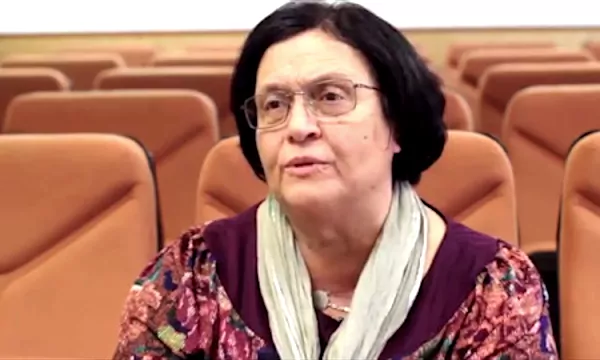
Presided over by the Rector, Joan Guàrdia, the session also featured contributions from former Vice-Rector Lourdes Cirlot; the President of the Spanish Association for Methodology in the Behavioral Sciences, Nekane Balluerka; the President of the Academy of Psychology of Spain, Heliodoro Carpintero; the Dean of the Faculty of Psychology at the University of Barcelona, Montserrat Celdrán; the Dean of the Official College of Psychology of Catalonia, Guillermo Mattioli; and Professor Antonio Solanas of the Faculty of Psychology, as well as her widower, Pedro Sánchez. The Real Academia was represented by the academicians Maria Àngels Calvo, Esther Subirà, Joaquim Gironella, Carlos Grau, and Academician-Elect Josep Moya. The tribute included moments of deep emotion when several videos of Anguera were shown.
“Teresa is part of the heritage of the University of Barcelona,” Guàrdia stated, recalling his earliest memories of her as a student and later as a departmental colleague. Cirlot, for her part, remembered their time together on the university’s governing team, when Anguera served as Vice-Rector for Academic Management, and evoked the Minerva Project, aimed at promoting a humanities park. Solanas highlighted her institutional profile, marked by the assumption of multiple leadership responsibilities, and the nationwide recognition she received, including several honorary doctorates and professional distinctions. In the field of research, he emphasized that her continued presence in international rankings—such as those of Stanford University—confirmed a sustained trajectory of excellence. Celdrán underscored the honoree’s dual role as both an educator and an institutional leader.
Beyond the university, Balluerka described Teresa Anguera as a benchmark scholar and highlighted her decisive role in the training of researchers. Mattioli offered a more personal testimony, describing his relationship with his doctoral supervisor as almost psychotherapeutic: “She accompanied me through subtle leadership, with a kind, humble academic authority.” Carpintero placed Anguera as a central and rigorous figure in Spanish psychology and recalled her early academic years when, as a student of Miquel Siguan, she took up observational methodology almost by chance following a student strike. This circumstantial episode, he explained, ultimately led to a specialization that made her an undisputed authority in the field.
Anguera was an expert in methodology in the behavioural sciences and held several management positions at the University of Barcelona. Her contributions to research through observational methodology enabled her to generate a comprehensive theoretical, strategic, and technical framework for understanding any type of human behaviour in its natural context. She authored more than 300 research articles and 182 publications, including books and book chapters. Her work in knowledge transfer is also noteworthy, with over 470 conference communications, 150 lectures, and 72 invited keynote addresses. She was awarded honorary doctorates by the University of La Laguna, the University of Las Palmas de Gran Canaria, the Pontifical University of Salamanca, and the University of Lleida.