

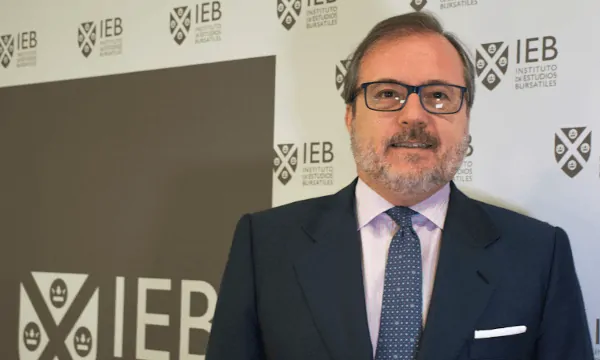
Dr. Daniel Berzosa
Daniel Berzosa, Professor of Constitutional Law and Fundamental Rights at Cunef University, the Institute of Stock Market Studies (Instituto de Estudios Bursátiles), and IE Law & Business School; member of the Global Academy and of the Scientific Council of the international collective Citizens pro Europe; and full academician and member of the Governing Board of the Royal European Academy of Doctors (READ), published on January 1 an article titled «Stability and Regeneration» in the prominent section «La Tercera» of the newspaper «ABC». In it, he addresses the main institutional and social challenges facing Spain in 2026, arguing that democratic stability is not synonymous with passivity, but rather with an active commitment to coexistence and freedom.
«The year 2026 is shaping up to be decisive for European democracies and, especially, for Spain. The centrifugal forces in politics, the technological revolution, the questioning of the consensuses that shaped post-war Europe, and the erosion of citizens’ trust have created an unprecedented environment that compels us to revisit the foundations on which our coexistence rests. This is not about reforming for the sake of reform, nor about idealizing change as a universal solution, but about strengthening what works, updating what has become outdated, advancing economically and socially, and protecting the balances that make freedom possible. In this context, the Crown—and particularly His Majesty King Felipe VI—plays a unique role as a symbol of institutional stability and a point of reference for guidance in turbulent times», the academic begins his reflection.
Berzosa emphasizes that political polarization, the deterioration of public debate, and the partisan use of institutional checks and balances threaten the cohesion of the constitutional system. In response, he argues for regeneration based on respect for the rules, the separation of powers, and the genuine independence of constitutional bodies, which must act as guarantors of the general interest rather than as extensions of political confrontation. The article highlights the role of the State’s institutions of continuity as stabilizing elements in times of tension. In this regard, the academic stresses the need to preserve solid institutional frameworks capable of absorbing political conflict without eroding the constitutional architecture or endangering democratic coexistence.
 The author maintains that regeneration cannot be limited to legal or structural reforms alone, but must also involve an ethical and cultural renewal of politics. This entails strengthening the accountability of those in power, raising the standard of public discourse, and restoring consensus as a fundamental tool of democratic governance. «The challenges of 2026 do not call for a constituent rupture, but for an intelligent renewal of the constitutional pact. Strengthening institutions, updating structures, protecting rights, and understanding that stability is not passivity but an active commitment to freedom and coexistence. Spain and the Spanish people have the opportunity—and the responsibility—to demonstrate that a solid and well-interpreted Constitution can continue to be the best instrument for guaranteeing plurality, progress, and freedom. In this endeavor, the Crown, as an institution of continuity and a point of reference for all Spaniards, will continue to be an essential pillar of the stability that allows us to move forward while reinforcing the foundations that have made our democracy possible», the expert concludes.
Berzosa is a member of the Society of Diplomacy and Political Science of the United States, coordinator of the International Observatory on the Regulation of Public Sector Entities at the University of Santiago de Compostela, a member of the organizing committees of the World Law Congresses held in Cartagena de Indias (2021) and Madrid (2019), and the author of books and scientific articles published in prestigious journals. He is also a well-known commentator on legal and political science issues in Spain’s leading media outlets.