



Esther Subirá, Professor at the Faculty of Economics and Business of the University of Barcelona, member of the Board of Governors of the College of Economists of Catalonia and full member and member of the Board of Governors of the Royal European Academy of Doctors (READ), addressed the demographic challenges facing Europe the 10th International Academic Meeting held by the Royal Corporation between 15 and 20 March in various German cities under the general title “The Rhine as a Current of Knowledge: Cross-Border Dialogues.” The academic presented the lecture “Territorial Ageism and European Reconfiguration: the Blue Banana and the Challenge of Irrelevance.” Along these same lines, Subirá had already spoken last October on this crucial issue in the Telematic Classroom of the Academy of Sciences, Engineering and Humanities of Lanzarote, of which she is a corresponding member, where she delivered the lecture “From the Pyramid to the Cylinder: Longevity and Exclusion, the Paradox of Ageism.”
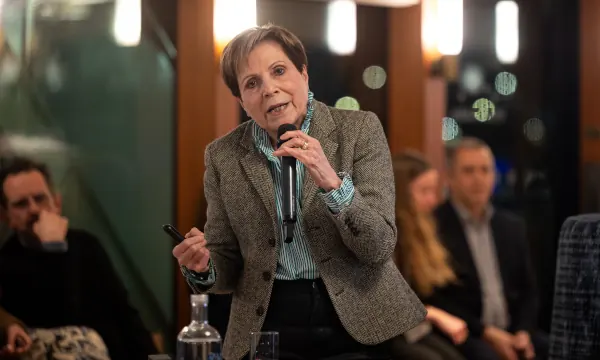
Dr Esther Subirá
Referring to the historic “Blue Banana,” the industrial corridor linking the Rhine and the Rhône from north-western England to northern Italy, and by extension to industrial Europe, the expert pointed out that the continent is facing a critical moment marked by demographic ageing, the loss of geoeconomic centrality and an accelerated technological transition, accompanied in turn by a new phenomenon she describes as territorial ageism. This is a view that considers regions with a long industrial history to be obsolete when it comes to leading the economy of the 21st century. This prejudice, she explained, unfairly penalises consolidated territories in favour of emerging areas, ignoring the fact that their accumulated experience, human capital and infrastructures can become a fundamental strategic advantage.
The economist recalled how, before the Second World War, Europe’s productive heart was not limited to the western axis. Regions such as Silesia, Bohemia, the Rhineland, Pomerania and northern Italy formed a highly integrated and connected industrial fabric. However, the division of the continent after the Yalta agreements and the Cold War caused the artificial marginalisation of large areas of central and Eastern Europe, consolidating the primacy of the western Blue Banana, which today shows clear signs of structural fatigue. At present, many of its regions exceed 30% in the so-called senior dependency rate, their productivity has been weakened, and their external technological dependence has increased. At the same time, she warned, Europe must face strong competition from the United States and China in key fields for the future such as artificial intelligence, advanced robotics and clean technologies.
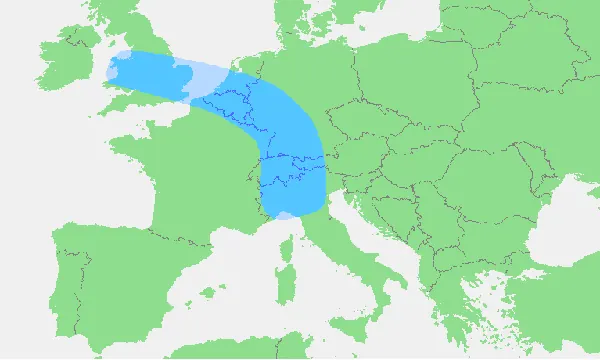
The Blue Banana, also known as the European Megalopolis or European Backbone
Faced with this panorama, Subirà rejected the idea of inevitable decline and proposed a resilience strategy based on three pillars. First, to promote large-scale industrial missions inspired by the approach of fellow economist Mariana Mazzucato in order to direct public and private investment towards specific goals such as technological autonomy, the energy transition and advanced manufacturing. Second, to encourage territorial reconnection by integrating the Blue Banana with other emerging corridors, such as the Mediterranean Golden Banana, which links Valencia with Genoa, and the Green Banana, the arc connecting the Adriatic with the Baltic through Vienna, Prague, Budapest and Warsaw. Lastly, to promote institutional renewal that would allow progress towards a more polycentric Europe, capable of reducing productivity gaps and strengthening cohesion between the western core and the peripheries. For the expert, European maturity is not equivalent to decline, but can instead become the foundation of a new sovereignty based on knowledge, institutional stability and integrative capacity.
Subirà is a recognised researcher in the fields of finance and marketing and has taught at various international universities and business schools. She is a member of the Board of Governors of the College of Economists of Catalonia and has been recognised by the General Council of Economists of Spain with the Medal for Service to the Spanish Economy for her distinguished practice of the profession of economist and her dedication to the professional institution and to society in general.