

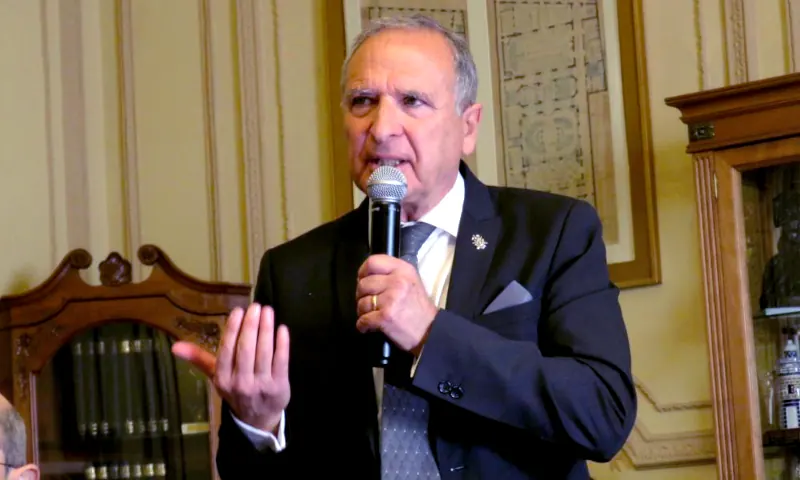
Mr. Jesús Alberto García Riesco
Jesús Alberto García Riesco, Colonel in the Spanish Army, member of the Spanish Association of Military Writers and contributor to the Royal European Academy of Doctors (RAED), analyses the current school of thought that challenges modernity and its institutions and has evolved into what he considers a dangerous form of destructive cynicism in the paper “Postmodernism and European security”, which will be included among the works presented during the 10th International Academic Meeting held by the Royal Academy between 15 and 20 March in several German cities under the general title “The Rhine as a current of knowledge: cross-border dialogues”. For the expert, postmodernity challenges the Enlightenment’s claim to universal knowledge and the belief that science can attain truth, regarding history as an ideological construct based on metanarratives.
“Postmodernism identifies the existence of multiple realities and refuses to recognise not only the existence of universal laws and grand theories, but also the consistency of any idea. By rejecting rational thought, it removes the foundation on which the values of modernity rest. Europe must be prepared to face a high-intensity conflict in which, as occurred during the world wars of the 20th century, it will need to mobilise the hearts and minds of its citizens. However, free societies lack the resilience required to overcome the hardships of conflict, because postmodernism does not regard society as a community governed by a common purpose, but as a collection of isolated individuals seeking their own gratification,” the expert summarises in his contribution.
According to the author, postmodernism emerged after the Second World War as an intellectual movement that questions grand narratives, universal laws and rationality, maintaining that there is no single truth, but rather multiple and relative realities, while promoting a form of hedonistic individualism.
This has generated what he defines as a collective numbness that weakens the resilience required to confront existential threats. García Riesco also warns that, while Europe must prepare to mobilise as it did during the world wars of the 20th century, postmodern societies lack the willingness to make sacrifices. After the Cold War, the continent took refuge in the theory of democratic peace and in the illusion that trade, international institutions and technology would render conventional warfare obsolete.
For the expert, the figures presented are revealing. Trust in institutions is low in countries such as the United Kingdom, at 39%; Germany, at 45%; and Spain, at 46%. Fewer than half of Europeans would be willing to fight for their country. Support for Ukraine is uneven and, in many cases, lukewarm. European armed forces have been drastically reduced since 1990: Germany has lost 85% of its combat formations; Italy, 66%; and France, 58%. Total personnel numbers have fallen from two million to fewer than 800,000. Recruitment difficulties, high attrition rates in France, Germany and the United Kingdom, and an aversion to casualties complete this picture of weakness. By contrast, Finland stands out for its comprehensive defence model: universal conscription, high levels of public awareness and the capacity to mobilise hundreds of thousands of reservists rapidly, stemming from a historical memory shaped by survival.
The author concludes that Europe is living under the dangerous illusion of eternal peace and soft power. Postmodernism has left it morally disarmed, fragmented by internal divisions and dependent on technology and external allies. Unless it recovers a common narrative, shared values and a strong defence consciousness inspired by figures such as George Marshall, the continent risks being unable to respond to a conventional threat such as that posed by Russia. Faced with this situation, García Riesco calls for a new social contract that informs citizens of the real dangers and restores solidarity and the willingness to make sacrifices before it is too late. His diagnosis, supported by academic references and recent statistics, raises an uncomfortable but necessary debate about the future of European security in an increasingly uncertain world.