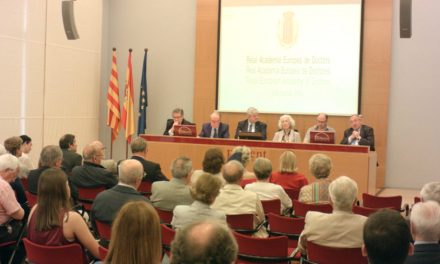


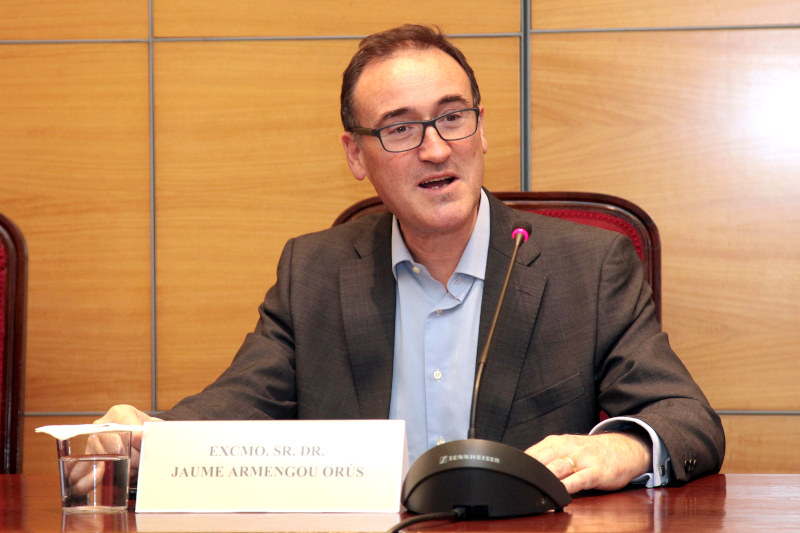
Dr. Jaume Armengou
Jaume Armengou, Director of the Decision Analysis Department at IESE–University of Navarra business school and Numerary Member of the Royal European Academy of Doctors (READ), directed the first edition of the IESE Infrastructure Meeting on 12 May at IESE’s Madrid campus, a conference that brought together some of the leading figures in the sector to analyse its future prospects. The meeting, organised in collaboration with the College of Civil Engineers, Channels and Ports–Caminos Madrid, focused on current issues, including transport reliability, the continuity of critical services such as water and energy, adaptation to climate change, financing, and the improvement of asset operation and maintenance.
Armengou himself led the opening session together with Gonzalo Fernández, member of the Governing Board of the College of Engineers, under the title “The decade of decisions: infrastructure, well-being and competitiveness in Spain and Europe”. “We are living at a time when decisions on infrastructure can no longer wait. We need clarity because this decade is critical: structural tensions are converging, such as limited fiscal space, the energy transition, urban concentration, demographic ageing, logistical vulnerability and climate pressure, all of which require action with strategic vision and a sense of urgency,” the speakers stated.
This presentation was followed by five round tables. The first, “Making it work tomorrow: transport reliability and system coordination”, featured Sergio Vázquez, President of the Centre for Research in Economic Engineering; Julián Núñez, President of the Association of Construction and Infrastructure Concession Companies; and Alfonso Sánchez, CEO of the Madrid Municipal Transport Company, and was moderated by María José Rodríguez Largacha, member of the Governing Board of the College of Engineers. Under the title “Critical services without interruptions: water and energy as the backbone”, the second round table included Blanca Losada, President of Fortia Energía and former President of Unión Fenosa Distribución; Yago Mijangos, Director for the Middle East, Australia and Western Europe at Fomento de Construcciones y Contratas; and Luis Villarroya, President of Eptisa. It was moderated by José Miguel Atienza, Director of the Higher Technical School of Civil Engineering, Channels and Ports of the Polytechnic University of Madrid.
The third session was entitled “Connecting the city and the territory: a holistic perspective on transport and mobility infrastructure” and featured Pere Calvet, Director of Alsa in Catalonia and Dean of the College of Civil Engineers–Catalonia Demarcation; Concha Santos, President of the National Association of Independent Constructors; and José Manuel Vassallo, Professor of Transport at the aforementioned Higher Technical School of Civil Engineering, Channels and Ports and Director of Transyt. In this case, Gonzalo Fernández acted as moderator. The fourth, “Hot proposals for water and energy policies”, featured Mariano González, CEO of Canal Isabel II; Marisol Martín-Cleto, former Director General of Prointec and Senior Partner at Syntagma Partners; and Rafael Mateo, former CEO of Acciona Energía, and was moderated by Juan Luis López Cardenete, Professor at IESE Business School.
 The conference closed with the round table “Bankable projects, sustainable systems: financing and rules of the game”, which featured Nuria Haltiwanger, Director of Infrastructure Investments at Grupo ACS and President and CEO of Iridium Concesiones de Infraestructuras; Belén Marcos, President of Vinci Highways; and Juan Franco, President of Tecniberia. This final debate was moderated by Carles Vergara, also a lecturer at IESE Business School. The meeting concluded with an executive summary and the identification of five key decisions to be taken in the coming months, assigning those responsible for monitoring them and establishing a series of verifiable milestones within the first 90 days. “We want the meeting to be a turning point: a space where people do not merely talk, but where a concrete agenda is defined and a monitoring mechanism is agreed to ensure continuity,” stated Armengou and María Dolores Esteban, Dean of the College of Civil Engineers, Channels and Ports–Caminos Madrid.
Armengou was a member of IESE’s Management Board as Secretary General between 2018 and 2025 and is a member of the faculty in the Decision Analysis Department. In 2007, he was appointed Vice-Rector for Academic Organisation and Faculty at the International University of Catalonia and professor at its School of Architecture. In 2016, he became Vice-Rector for Academic Organisation and International Relations. He has also taught and collaborated on research projects at the Polytechnic University of Catalonia, the University of Navarra, the University of California, Berkeley and the University of Piura. He has patented and registered various utility models and software programmes. His research focuses on project management and structural design in civil engineering.