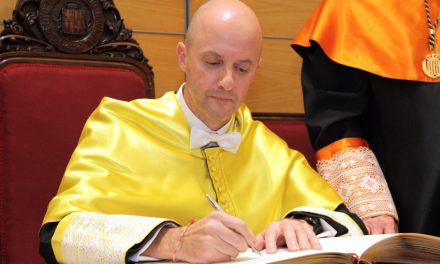


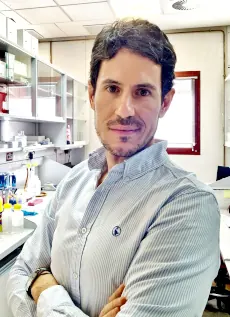
Dr Javier Redondo
Javier Redondo, scientist at the Margarita Salas Center for Biological Research, an institute affiliated with the Spanish National Research Council (CSIC), and elected Corresponding Member of the Royal European Academy of Doctors (READ), leads a study revealing how leukemia cells that grow for several days in a highly dense three-dimensional environment—similar to that found in human tissues—subsequently retain lasting deformations in their nucleus and changes in the packaging of DNA within it. The research has shown that these changes persist even after the cells are removed from the physically constrained or pressure-confined environment in which they developed, suggesting the existence of a “mechanical memory” with potential implications for tumor processes. The experimental study has been published in the prestigious scientific journal Cell Reports Physical Science.
The team led by the future academic observed that these cells exhibit nuclear deformations, less compact chromatin, and alterations in gene expression, affecting hundreds of genes. In addition, they accumulate greater DNA damage and display increased sensitivity to certain chemotherapeutic drugs, which could have therapeutic implications. However, these cells also demonstrated a reduced ability to invade organs such as the bone marrow, spleen, or liver in experimental models, suggesting that the physical environment may influence cancer aggressiveness. The findings highlight the importance of the three-dimensional environment in tumor development and progression and open new avenues for improving cancer treatment design by taking into account how physical forces affect cancer cells.
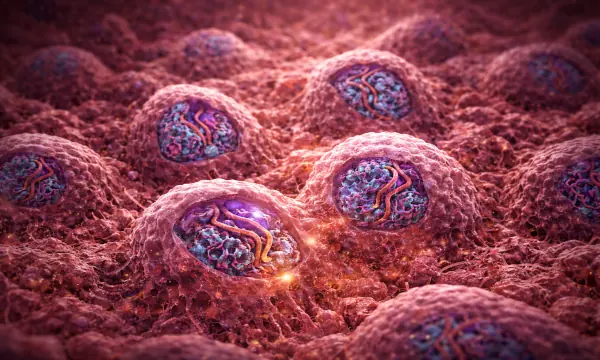
Representation of leukemia cells
“The results of this study underscore the importance of considering the three-dimensional environment in cancer biology and in the design of therapeutic strategies, and they pave the way for analyzing whether these adaptations also occur in other tumor and non-tumor cells, in order to identify the possible mechanisms involved in the persistence of mechanical memory,” states a press release published on 18 February by the CSIC. The statement highlights the significance of the scientist’s work and points to its potential future applications and impact on oncological therapies.
Redondo is also developing the research project “Epigenetic Mechanisms Related to the Invasive Capacity of Tumor Cells” within the framework of the BBVA Foundation’s Leonardo Network, a line of research he initiated at the Center for Cell-Matrix Research at the University of Manchester. After earning his PhD from the Complutense University of Madrid, he worked as an associate researcher at Spain’s National Center for Biotechnology. He is a member of the European Hematology Association, the Spanish Society of Immunology, and the International Society for Matrix Biology, among other Spanish and international scientific organizations. His admission to the READ is scheduled for 26 May, when he will deliver the lecture “The Cell as an Integrated Unit of Mechano-Chemical Signals: Challenges of Biological Complexity, from Tensegrity to the Nucleus.”