

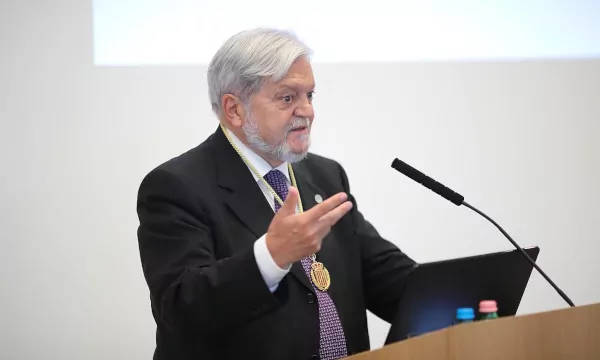
Dr. Joaquín Callabed
Joaquín Callabed, president of the Club of Social Pediatrics, corresponding member of the Royal Academy of Medicine of Catalonia and the Royal Academy of Pharmacy of Catalonia, and Numerary Member and vice-president of the Section of Health Sciences of the Royal European Academy of Doctors (READ), shares with the academic community a new series of articles in which he succinctly and divulgatively addresses the figures and legacy of various authors of Classical Antiquity. Specifically, these are «The Neoplatonist Legacy of Plotinus», «The Teachings of Cicero», «Xenophon, a Cinematic Adventurer Philosopher», «The Influence of Plutarch», and «Thucydides, Father of Scientific Historiography», published between November 27 and December 10 in the «Expert Readers» section of the digital edition of «La Vanguardia», whose readers’ community he actively belongs to.
In «The Neoplatonist Legacy of Plotinus», the expert dwells on the life and work of the renowned Hellenistic philosopher, author of «The Enneads», considered the founder of Neoplatonism. «Plotinus’s work is essentially an original commentary on Plato’s writings alongside other philosophical schools, in a far more structured way than that of Philo of Alexandria. He was born in Egypt (around AD 205 in Lycopolis) and educated in Alexandria, where he studied under Ammonius Saccas, known for attempting to harmonize the teachings of Aristotle and Plato. He later settled in Rome. His work exerted significant historical influence on various authors and religions, as well as on Marsilio Ficino’s Florentine Academy. His life and philosophy have left a profound mark on the history of Western thought», he explains.
In «The Teachings of Cicero», the president of the Club of Social Pediatrics focuses on the Roman politician, orator, writer, and philosopher—moralist and disseminator of Greek culture—universally recognized. «Regarded as one of the most important authors in Roman history, Cicero was responsible for introducing the most renowned Hellenic philosophical schools into Republican intellectual life, as well as for creating a philosophical vocabulary in Latin. He is remembered for his humanistic, philosophical, and political writings. His letters, most of them addressed to Atticus, achieved enormous recognition in European literature for introducing a refined epistolary style», he notes.
In «Xenophon, a Cinematic Adventurer Philosopher», Callabed introduces the figure of a prominent disciple of Socrates who took part in the expedition of Cyrus the Younger’s Ten Thousand mercenaries in Persia. «Xenophon (c. 430, Athens–355 BC, Corinth) was born into a well-to-do family. He was a distinguished historian, soldier, and philosopher of ancient Greece, known for his detailed chronicles of his time and his works on household economy, cavalry, politics, and Socratic philosophy. He is one of the key sources of information about Socrates, who was his teacher. Among his works stands out the continuation of Thucydides’ unfinished Hellenica. He participated in Cyrus the Younger’s expedition against Artaxerxes II and in the retreat of the Ten Thousand Greeks, which he recounts in the Anabasis», he explains.
 The academic devotes «The Influence of Plutarch» to reviewing the role played in the history of universal thought by the work of the renowned historian and scholar known for his «Parallel Lives», whose philosophy centers on morality, virtue, education, ethics, and individual happiness. «Plutarch was a philosopher of Platonic orientation. He opposed both Stoicism and Epicureanism. He is important for the doxographic information his work provides—that is, the compilation of opinions or ideas of philosophers and scientists of the past—which he includes in some of his writings. He pays little attention to the most significant deeds of each figure, focusing instead on details and anecdotes that best reveal their character», he states.
Finally, in «Thucydides, Father of Scientific Historiography», the expert focuses on the well-known Athenian historian and general, author of the «History of the Peloponnesian War». «In his rigorously written work, he discards anecdotal, literary, or fantastical elements and minimizes divine intervention as much as possible, although he considers it in human motivations. He analyzes both the proximate and distant causes of events and seeks the objective motivations of Athens or Sparta, as well as the personal motivations of the protagonists. His dense and concise style was later imitated by Roman historians such as Sallust and Tacitus. Thucydides was particularly interested in the relationship between human intelligence and judgment, fortune and necessity, and the idea that history is too irrational and unpredictable to be foreseen», he concludes.