

Dr Bernat-Noël Tiffon
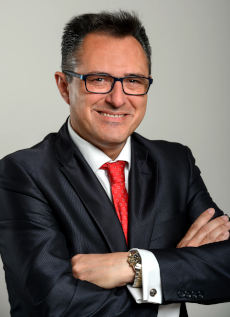
Bernat-Noël Tiffon, a renowned expert in legal and forensic medicine, President of the Superior European Council of Doctors and Doctors Honoris Causa, Professor of Legal Psychology at Abat Oliba CEU University, and Professor of Criminal Psychology and Gender and Domestic Violence at ESERP Digital Business School & Law School (University of Vic–Central University of Catalonia), as well as a Corresponding Member of the Royal European Academy of Doctors (READ), is the subject of two interviews published on the occasion of the release of Saga Tiffon: From Romanticist Surgery to Forensic Psychiatry and Psychology. Research into a Three-Century Family Medical and Social Journey (J.M. Bosch Editor). In them, he reviews a long and intense family career devoted to medicine and psychology. The first interview appeared on 19 December on the website of RAC-1, Catalonia’s leading radio station, while the second was published the following day on the specialist portal Perfil.
On RAC-1, Tiffon explains how the Barcelona of the Liceu and the anarchist bombings of the early twentieth century changed the lives of healthcare professionals in the city forever and shaped the destiny of the Tiffon medical lineage, established in Barcelona since the early nineteenth century and continuously devoted to the profession across six generations. «I am not aware of any other family lineage in Spain that has accumulated six consecutive generations devoted exclusively to healthcare over three centuries. There is another parallel Tiffon lineage, but I have followed and researched my own genealogical family line. There are also illustrious families, such as the Barraquers in ophthalmology, but I believe the continuity and temporal scope of our saga constitute a singular case—especially considering that the surname Tiffon is very rare in Spain.
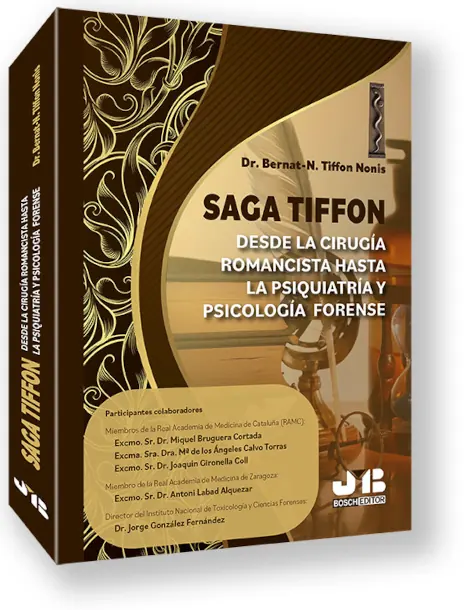 Safeguarding this history is an honour and a source of pride, but it also carries an emotional weight. As Dr. Miquel Bruguera notes in the book, it has been a successful family in its respective times. I feel there is a strong genetic or vocational influence passed down from parents to children, and being able to document it is my way of ensuring that this memory is not lost or forgotten,» the academic explains.
For its part, in Perfil, the author focuses on the present and recalls some of the crimes in which he has intervened as a forensic psychologist, such as the Guardia Urbana case. «The Guardia Urbana crime is a case that has been discussed, is discussed, and will be discussed in the future. It has had a great deal of impact and media coverage. Nevertheless, it would not have had such prominence had it not been framed within the police sphere and because all those involved were police officers. Without that professional context, it would probably not have received such coverage, or it might have appeared only as a brief news item, as sadly crimes occur every day. The trial lasted a month and a half, from February to mid-March 2020. From my personal and professional standpoint, it represented a turning point and a hinge in my career,» he reflects.
Tiffon has worked on criminological cases that are part of contemporary Spanish crime history with wide reach and social impact; he has taught at Spanish and international universities; and he is the author of more than 20 books on the subject. He is also a recognised communicator of academic forensic psychology as a speaker and as the organiser and manager of leading events and conferences in these fields. He holds national accreditation as an expert psychologist in legal and forensic psychology from the General Council of Official Colleges of Psychologists, and is a member of the American Academy of Forensic Sciences, the American Academy of Psychiatry and the Law, the Canadian Society of Forensic Science, the International Academy of Legal Medicine, the French Association of Criminology, and the Mexican Society of Criminology.