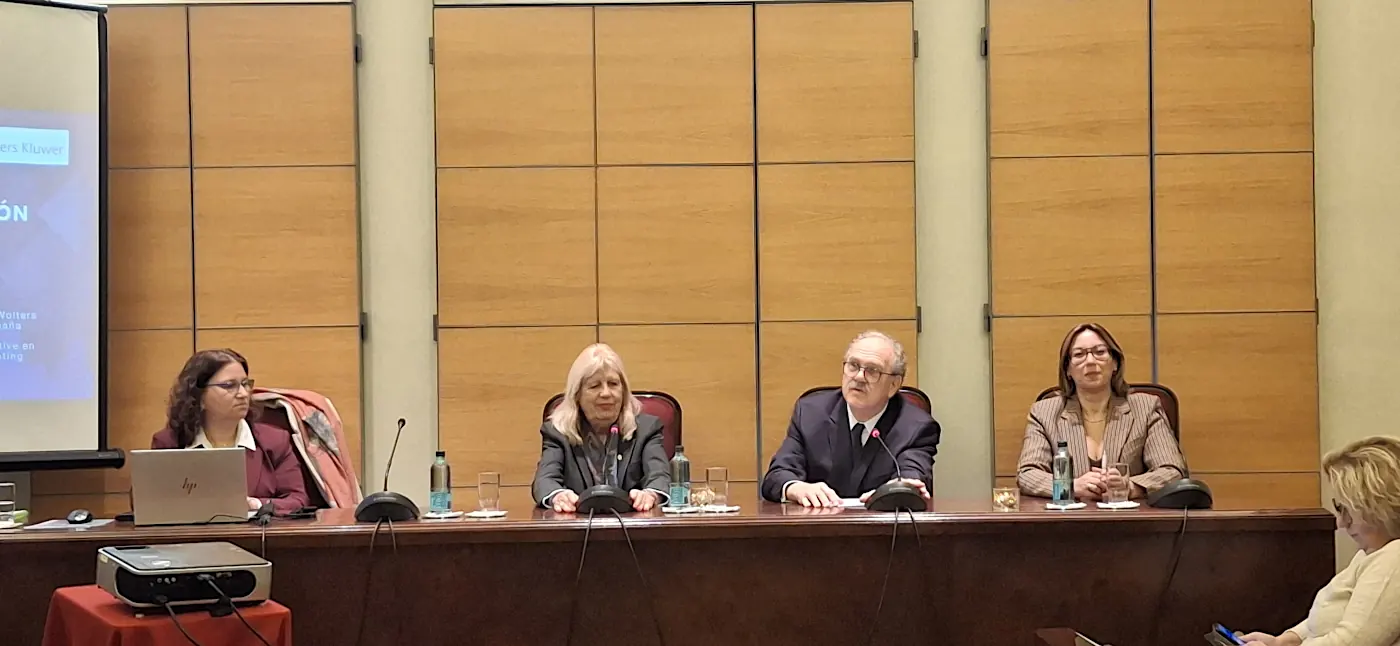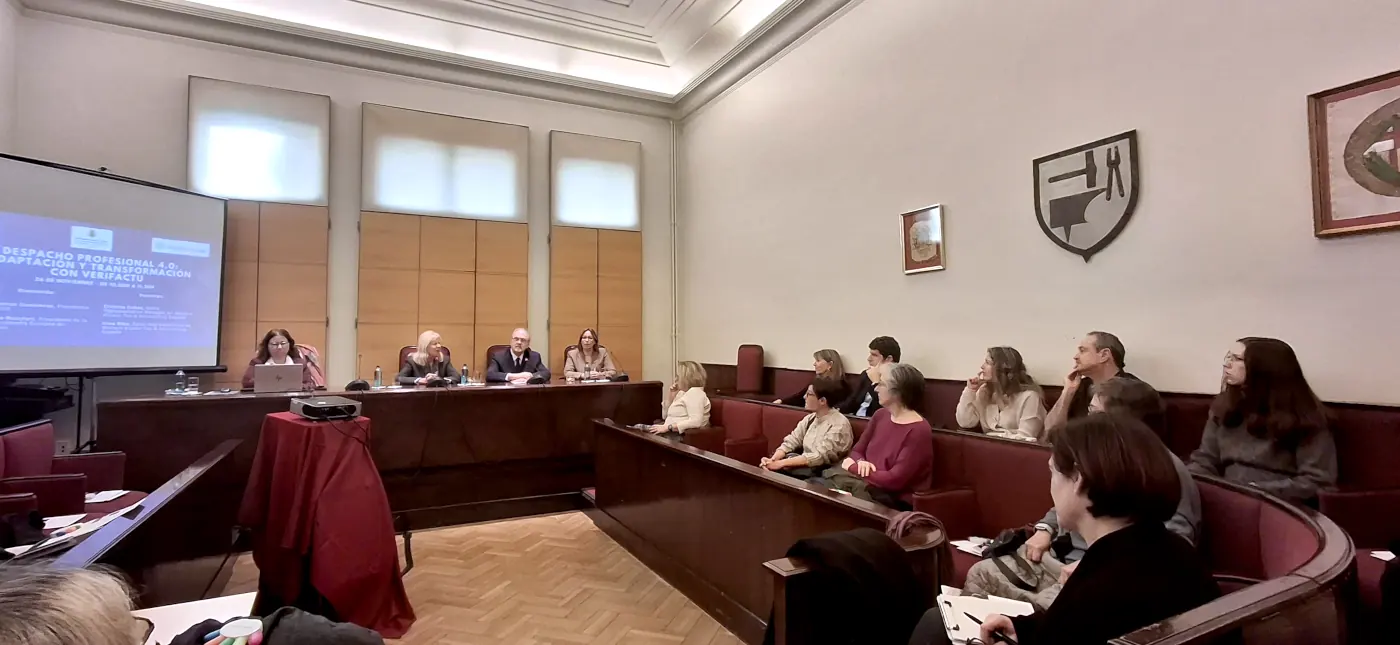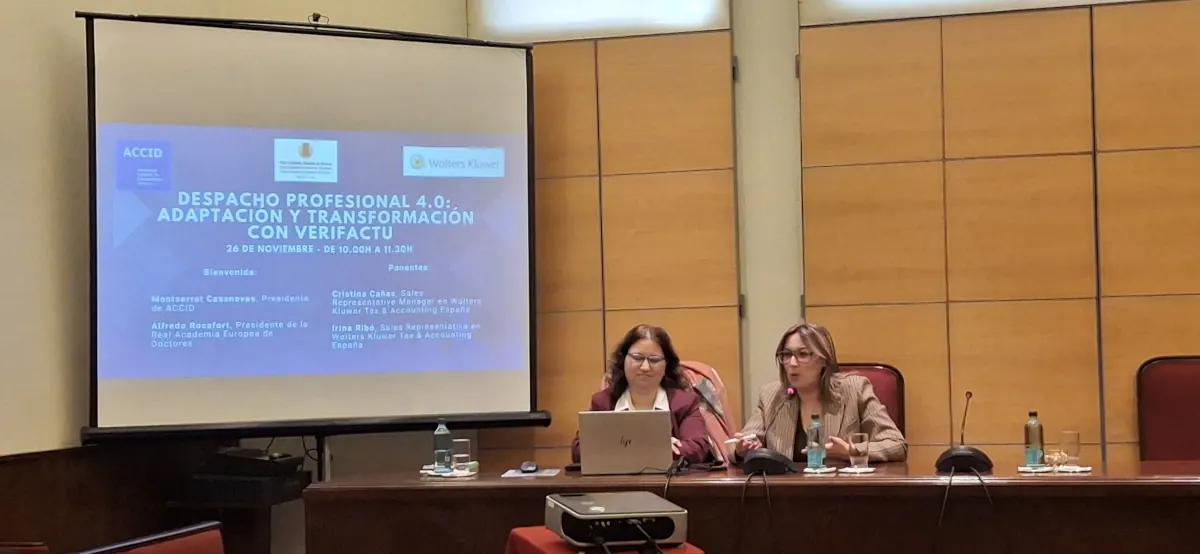



The Royal European Academy of Doctors (READ) organised, on 26 November, together with the Catalan Association of Accounting and Management (ACCID) and the business consultancy Wolters Kluwer, the session “Professional Firm Workshop 4.0: Adaptation and Transformation with Verifactu”, a conference aimed at managers and administrative and executive staff in relation to the new invoice verification model promoted by the Spanish Tax Agency, whose complexity has forced the Government to postpone its implementation. The event was held at Foment del Treball, the Academy’s headquarters, and featured presentations by experts Jordi Cot, Sales Representative Manager at Wolters Kluwer Tax & Accounting Spain, and Irina Ribó, Sales Representative at Wolters Kluwer Tax & Accounting Spain.
The session was chaired and introduced by Alfredo Rocafort, Professor of Financial Economics and Accounting at the University of Barcelona and President of the READ Governing Board, and Montserrat Casanovas, Professor of Financial Economics and Accounting at the University of Barcelona, Numerary Member of the READ and President of ACCID. The READ and ACCID renewed this year the collaboration agreement signed in 2016 and strengthened in 2022 to promote and develop joint activities and publications of common interest. The READ is also a protecting partner of ACCID.
The session was divided into two thematic blocks addressed throughout a full morning programme. In the first block, both experts introduced the new Verifactu verification system and its impact on the sector, outlining strategies to communicate the change to clients, offering tools and channels to facilitate the transition, and presenting practical success stories in adaptation. In the second block, they examined the automation of accounting processes with Verifactu and the integration of platforms and software, described new workflows transitioning from the current paper-based system to a digital one, and provided key insights to improve efficiency and reduce errors during a dynamic session of networking and learning.
Under the Law on the Prevention and Fight Against Tax Fraud, the Verifactu system requires that invoices from any company or self-employed professional be issued exclusively through certified software ensuring authenticity, integrity and traceability, obliging professionals to generate records with security measures such as digital signatures, QR codes and digital footprints. Although the Tax Agency has developed a free application to help taxpayers comply with the regulation, the system has been postponed following complaints from professional and business associations regarding its complexity and difficulty of implementation.
This session adds to the numerous joint initiatives carried out by the READ and ACCID within the framework of their close collaboration over recent years. Both institutions, together with the Barcelona School of Management of Pompeu Fabra University, published the book “How to Research?” (Profit Editorial), a work featuring contributions from several READ Numerary Members who presented the main research techniques applied to different fields of knowledge, including the drafting and presentation of scientific work in its various academic formats: research project, undergraduate thesis, master’s thesis and doctoral dissertation.
The Catalan Association of Accounting and Management was founded in 2002 with the aim of becoming a meeting point for professionals and academics working in Catalonia in the field of accounting. It emerged from an agreement between the College of Chartered Public Accountants of Catalonia, the College of Economists of Catalonia, and the College of Mercantile and Business Graduates of Barcelona. Later, the College of Secretaries, Auditors and Treasurers of Catalonia and the Official College of Administrative Managers of Catalonia also joined. The organisation aims to complement the work of other professional bodies by providing a platform for opinion and debate on current topics in accounting, promoting research and the presentation of new developments in accounting and management, publishing specialised works, organising conferences, seminars and congresses, improving financial transparency, and promoting best practices in the dissemination of financial information.