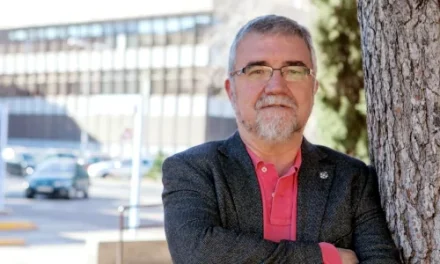



Dr. Antoni Garrell
Antoni Garrell, President of HM Hospitales and Honorary Member of the Royal European Academy of Doctors (READ), shares with the academic community the article “The Future Will Not Be Decided by Machines, but by Talent,” in which he reflects on the impact of his latest book, “The Second Digital Revolution: A New Era for Humanity”. In the same vein, the academic has recently published the articles “The Future of Engineering: Is Our Education Adequate?” and “Europe Does Have the Capacity to Achieve Technological Sovereignty,” which appeared on 19 and 22 January, respectively, in the digital publication Fulls d’Enginyeria, edited by Enginyers de Catalunya, the College and Association of Industrial Engineers of Catalonia, and in Crónica Global, a supplement of the digital newspaper El Español.
Garrell is an industrial engineer from the Polytechnic University of Catalonia, holds a master’s degree in Management and Administration, and completed doctoral studies in Decision Support Systems. A specialist in innovation and the knowledge economy, he has developed an extensive professional career in both computational technology and organizational and strategic management. He has held executive positions at companies such as Arthur Andersen, La Caixa, the La Salle University and Technology Foundation, and the Textile Design Foundation. Since 2021, he has served as President of HM Hospitales. He has been a member of several corporate boards and advisory councils and has held institutional roles such as President of the Cercle per al Coneixement and member of the Executive Council of the Ramon Llull University Foundation.
In academia, he has delivered lectures and conferences at international universities and is the author of more than 850 technical, economic, and opinion articles, as well as author or co-author of around ten monographs on digital technology, multimedia, and industry. He was also founder of the technology magazine “INPUT.” His most recent books are “Industry 4.0 in the Digital Society” (2019) and “Smart and Sustainable Products and Services” (2021). Garrell joined the Academy on 20 November with the inaugural address “The Second Digital Revolution: Are the Digital Economy and Artificial Intelligence Leading Us to a New Era of Humanity?”, in which he reflected on the profound changes generated by the transition toward a disruptive digital era, highlighting both its opportunities and challenges in light of previous transformative revolutions.
The Future Will Not Be Decided by Machines, but by Talent

A few days ago, a friend who attended my induction ceremony as Honorary Member of the Real Academia Europea de Doctores called to tell me he had just finished reading my book The Second Digital Revolution: A New Era for Humanity, which formed the basis of my inaugural address. Among other things, he told me: “Reading your latest book has led me to ask myself many questions about the future and about the two engines—artificial intelligence and the digital economy—that are driving this new era. It is true that companies need talent, intelligent and committed people, but it is also true that it is often difficult to integrate them into teams because they tend to live in doubt and find it hard to decide.”
His observation—that intelligent people often struggle to make decisions—led me to pose an unavoidable question: why do such individuals tend to experience more doubt than others, sometimes to the point that it affects their mood and leads to a certain inward withdrawal that hinders teamwork or decision-making?
The answer, grounded both in my professional experience and in a qualitative reading of contemporary organizational reality, is clear. When I refer to intelligent individuals, I primarily mean those with high cognitive capacity in analytical, rational, and critical domains—people capable of managing complexity, identifying patterns, and anticipating consequences—beyond the reductionist notion of intelligence as merely an IQ score. While there are also highly intuitive or action-oriented intelligent profiles, many such individuals naturally coexist with doubt as part of the way they process challenges and uncertainties in professional life.
Various studies indicate that higher cognitive and metacognitive capacity is associated with greater awareness of the limits of one’s own knowledge, which in turn increases the perception of uncertainty. At the same time, these individuals tend to possess a broader awareness of the world’s complexity, enabling them to perceive multiple variables, interdependencies, and consequences where others see simple certainties. This expanded vision can amplify uncertainty when information is incomplete or when no option appears unequivocally optimal.
However, intelligent individuals are usually highly critical of their own judgments. They are deeply aware of the limits of their knowledge and of the biases that may condition their perceptions. The literature suggests that such critical awareness is not a sign of insecurity, but rather an expression of intellectual humility—a constant questioning driven by respect for truth and for the consequences of decisions. Another relevant aspect is their intrinsic need for logical coherence and solid evidence. This internal demand often clashes with a world full of ambiguity and phenomena without clear solutions, making it difficult to identify a single, unequivocally correct answer. This can lead to doubt that complicates decision-making, further intensified by strong self-demands—traits that are often misinterpreted by those less inclined to deep analysis.
Nevertheless, doubt in intelligent individuals is not a sign of weakness but an attribute of a mind that confronts the world’s complexity with lucidity. From a qualitative perspective, this disposition toward doubt is a necessary condition for the advancement of knowledge and for tackling problems that initially seem unsolvable. This quality becomes particularly relevant in transitional times such as the present, within the framework of the second digital revolution. High cognitive capacity enables individuals to question, analyze, and search precisely for the best options in a context dominated by uncertainty—we know where we are, but not the final destination. For this reason, working with intelligent individuals is not only desirable but absolutely necessary if we are to successfully address the complex challenges of the new digital era that humanity is entering.
The assertion that it is both beneficial and essential to work with intelligent people—or, in other words, to attract and retain talent within organizations of all kinds—can be supported for several reasons. In my view, the four most relevant are as follows:
First, intelligent individuals possess a special capacity to perceive the complexity of reality. Where others see simple problems with immediate solutions, they identify variables, interdependencies, and medium- and long-term consequences. This expanded outlook helps avoid costly mistakes and hasty decisions.
Second, working with intelligent people elevates the level of thinking within teams. It compels better argumentation, clearer justification of decisions, and a rejection of seemingly simple solutions that often conceal significant risks. This collective exercise allows inconsistencies to be detected and errors minimized—errors that frequently become evident only when it is too late.
Third, they have the ability to formulate the right questions—those that identify relevant issues, open new paths, and facilitate progress in complex environments. This attitude, grounded in coherence and rigor, improves project quality and builds trust within teams.
Finally, intelligent individuals are engines of genuine innovation. Their critical spirit enables them to question what already exists, connect diverse ideas, and explore new possibilities with discernment and purpose. They do not innovate because it is fashionable, but out of conviction, fostering a culture of quality and excellence that enhances competitiveness while generating progress.
It must be acknowledged that working with intelligent people strengthens any organization—provided that integrating them into teams involves understanding, listening to, and complementing them appropriately. These reflections do not seek to establish a universal causal relationship, but rather to highlight observable patterns that, under suitable conditions, can generate a virtuous cycle that unleashes talent, embraces complex challenges, and achieves the satisfaction associated with work well done.
Ultimately, the transition to humanity’s new digital era will not be determined solely by the technologies we develop, the policies we design, or the productive systems we implement, but above all by the talent we are capable of attracting, nurturing, and retaining. Without intelligent, critical, and committed individuals, artificial intelligence and the digital economy will remain devoid of purpose. Cultivating, attracting, and retaining talent is not merely another strategic option; it is the fundamental pillar upon which the future must be built. Organizations that understand this in time will not only be more competitive but will actively contribute meaning, direction, and humanity to the new digital era into which we are entering.