

Speakers
- Bernat-Noël Tiffon Nonis. Author of the book. PhD in Legal and Forensic Medicine. Corresponding Member of the RAED
- Alfredo Rocafort. President of the Governing Board of the RAED.
- Mª Àngels Calvo. Vice President of the Governing Board of the RAED
- Joaquín Gironella. Vice President of the Governing Board of the RAED
- Miquel Bruguera Cortada. Director of the Academic Studies Unit of the Barcelona Medical Association (COMB).
A History of Medicine, a History of a Family Saga
 Many histories of Medicine can be told, always from very different perspectives. In the present case, the author offers a proposal that is entirely different from the rest of his work published to date: he invites us on a temporal and chronological journey through a History of Medicine spanning the last 300 years, with a single unifying element — the direct lineage of a family saga that has managed to remain and endure within the medical profession over these three centuries.
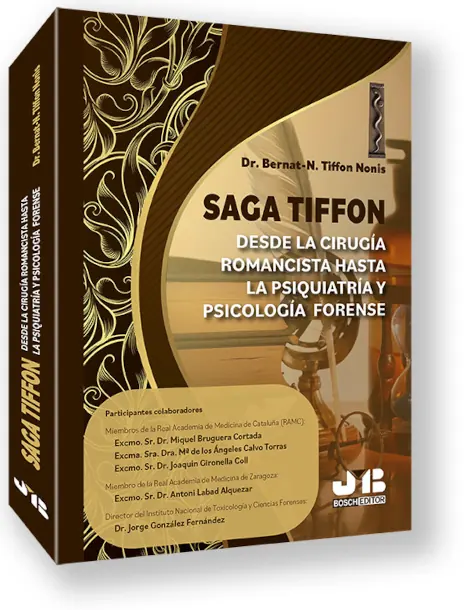
Medical Science is what it is today thanks to our ancestors who, through great dedication, determination and effort, made it possible for us to enjoy a healthcare system far more advanced than that of earlier times. This work, “Saga Tiffon: from Romanticist Surgery to Forensic Psychiatry and Psychology. (The investigation of a three-century historical-medical and social family journey)” (J.M. Bosch Editor, 2025), merely seeks to explain — from a humbly descriptive standpoint — one segment of the evolution of the many existing Histories of Medicine.
As stated by the author of the book and Member of the Real Academia Europea de Doctores (RAED), Dr. Bernat-N. Tiffon, and subject to possible error, the Tiffon Saga is very likely the only family line of direct descent (generation after generation) that has devoted itself to different medical specialties over five consecutive generations in Barcelona, and very probably throughout Spain as a whole (extending from the year 1807, and possibly even earlier).
From Romanticist Medicine and Surgery in the 19th century to the present day (21st century), this direct and successive line of healthcare professionals has left a professional imprint within their respective fields. Family oral traditions — some passed down from generation to generation, others unfortunately lost — are also gathered in this work. The importance of preserving family oral memory lies in understanding who we are today and shaping what lies ahead.
From the perspective of a contemporary passive observer contemplating the historical evolution of events, the family line under study has not only experienced the evolution of Medicine over these 300 years; it has also witnessed the historical development of the city of Barcelona, the fires at the Gran Teatre del Liceu, the socio-political movements of the period, the five major assassinations in Spanish history, and even anecdotal contacts with the Royal Household during the reigns of Alfonso XII and Alfonso XIII, among many other aspects.
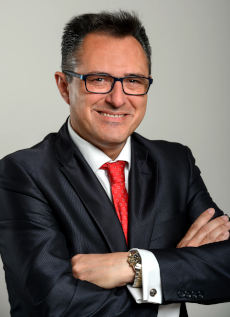
Dr. Bernat-Noël Tiffon
As the author explains, this has been a complex and demanding work of archaeological-historical engineering that brings together the five biographies of a single family line of succession, continuously extended over time. At certain points, it even becomes autobiographical on the part of the author himself, helping to contextualise the narrative.
As noted by Portal del Peritaje – Peritajes-Peritos, this is a medical and historical legacy rooted in Barcelona, where the work traces the origins of the Tiffon lineage back to the 19th century, when an ancestor from Narbonne (France) settled in the then walled city of Barcelona, dedicating himself to the surgical arts and podiatric medicine of his time.
From that moment on, generation after generation, the Tiffon family has been linked to medicine, psychiatry and forensic psychology, leaving behind a legacy that combines scientific rigour, human sensitivity and a vocation for public service.
The work is enriched by significant and distinguished contributions from Members of the Royal Academy of Medicine of Catalonia, the Royal Academy of Medicine of Zaragoza, the Director of the National Institute of Toxicology and Forensic Sciences, as well as valuable documentation from the General Archive of the Royal Palace (Directorate of Royal Collections, Royal Palace, National Heritage).
Organised by:
With the collaboration of: