


Josep Lluis i Ginovart enters as a Numerary Member of the RAED
The Hon. Mr. Dr. Josep Lluis i Ginovart, Doctor of Architecture, enters as a Numerary Member of the Royal European Academy of Doctors, with the speech “La practica geometriae de la arquitectura sacra” (The “practica geometriae” of sacred architecture).
Answer: Hon. Mr. Dr. Juan Trias de Bes, Doctor of Architecture
Foment del Treball Building, Via Laietana, 32, main, Room A, Barcelona, 08003
Wednesday, 23 April 2025
18:30 h
Format: Face-to-face and streaming
Inscription: Please confirm attendance at the Secretariat: secretaria@raed.academy or tel. 93 667 40 54
Description

Dr. Josep Lluis i Ginovart
The classical historiography of Gothic architecture argued that the construction of cathedrals stemmed from Neoplatonic knowledge and that their geometric definition and proportions reflected the knowledge of the bishops and their canons. Traditional topographic instruments made data collection in these structures very limited, and therefore their theories, under these premises, remained hypotheses. With the new Terrestrial Laser Scanner (TLS) techniques and their application, we can now precisely understand the built form, and these theses can be verified.
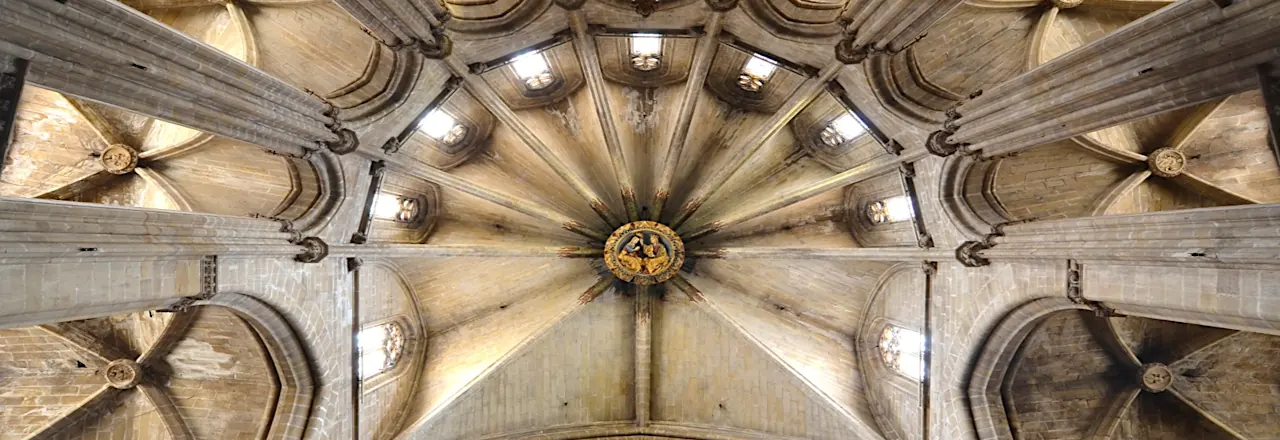
The discourse focuses on geometric aspects in the construction of the Gothic cathedral of Tortosa through the analysis of the design found in the Antoni Guarc parchment (c. 1345–1380) and the knowledge of the Chapter as seen in its library, with the study of codices ACTo 20, 80, and 236. These revealed the intellectual lineage of the main transmitters of the Timaeus: Calcidius, Macrobius, and Martianus Capella, as well as medieval authors like Gerbert of Aurillac, linked to Adelard of Bath (1090–1160), and a gloss on Euclid’s Elementa (c. 325–c. 265 BC) by Al-Ḥajjāj ibn Yūsuf ibn Maṭar.
The comparative and transversal reading of the cathedral of Tortosa through the knowledge of its promoters and their library; that of the medieval master through the analysis of the auxiliary drawings in Guarc’s parchment; and the statistical treatment of geometry based on the results from the Terrestrial Laser Scanner (TLS), have made it possible to prove the thesis: Worringer, Erwin Panofsky, and Otto von Simson were right.
With this methodology, we understand why the heptagonal apse of the cathedral of Tortosa is 150 palms wide, even though the heptagon does not appear in Euclid’s Elementa or Ptolemy’s Syntaxis Mathematica. Or the reason for the exaltation of the cathedral’s keystone, representing the Coronation of the Virgin, which measures ten palms in diameter, is surrounded by ten angels, is placed one hundred palms high, and weighs ten tons.
Follow the event live
You can follow the event live from this page.
#AcademicosRAED
#inspirandoElConocimiento
Organiza:

Con la colaboración de: