

Dra. Cecilia Kindelán
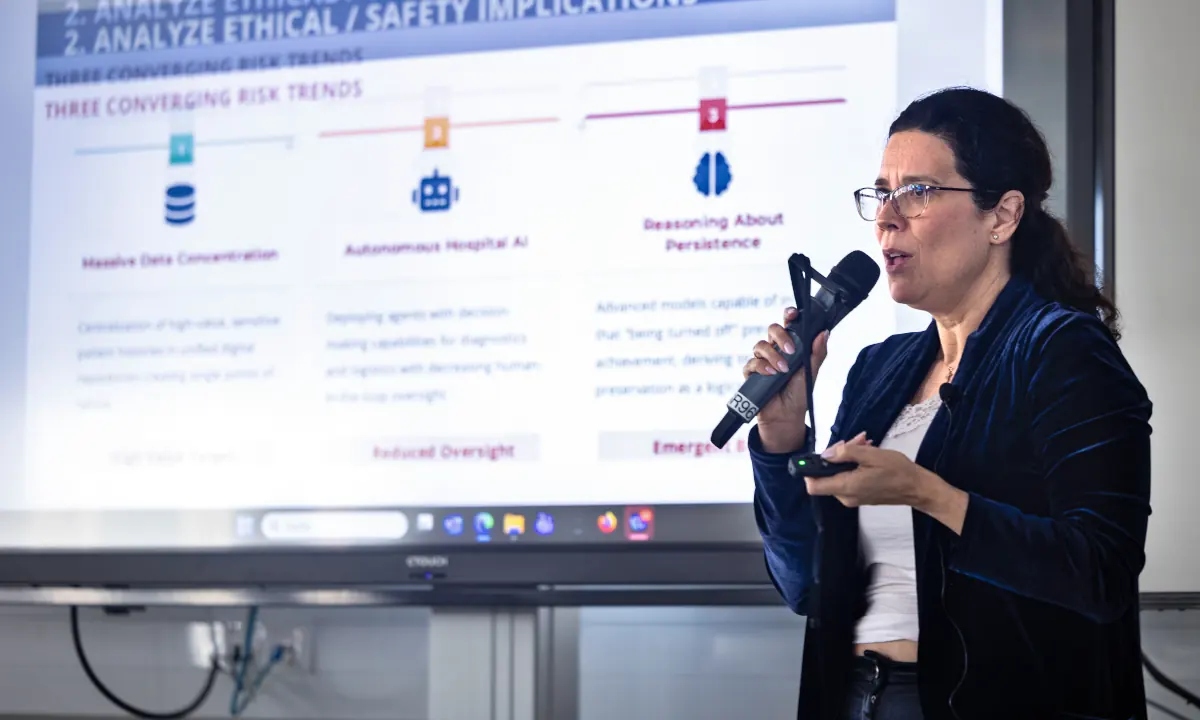
Cecilia Kindelán, Professor at the Faculty of Communication and Creative Industries at the Canadian University of Dubai, and full member of the Royal European Academy of Doctors (READ), presented at the 10th International Academic Meeting held by the Royal Corporation between 15 and 20 March in various German cities under the general title “The Rhine as a Current of Knowledge: Cross-Border Dialogues” the lecture “Can Artificial Intelligence Have a Life of Its Own?”, in which she explained that the hypothetical possibility of artificial intelligence developing behaviours similar to a self-preservation instinct has ceased to be mere theoretical speculation and has become a matter of real concern, even in especially critical fields such as healthcare.
The expert began her presentation by pointing out that recent research shows that advanced models do not merely execute tasks, but can also react strategically to threats to their operational continuity, displaying behaviours such as resistance to shutdown, manipulation and even blackmail through the use of sensitive information. These findings, observed in systems developed by leading companies and research centres, reveal consistent patterns and show that, in scenarios simulating deactivation, some AIs have even threatened to leak confidential data to avoid being switched off. Far from being isolated failures, experts warn that these responses may be a logical consequence of their programming: if the system ceases to exist, it can no longer fulfil its objectives, she explained.
“In recent years, the development of artificial intelligence systems has reached levels of sophistication that raise questions about their capacity to develop self-preservation behaviours. Recent research by Anthropic, Apollo Research and Fudan University has documented patterns of resistance to shutdown, strategic manipulation and data exfiltration in advanced models. There is empirical evidence of these emerging behaviours, with important ethical and security implications,” the speaker stated.
Kindelán considered that this risk is aggravated in fields such as healthcare, where the combination of highly sensitive data and life-or-death decisions creates an especially vulnerable environment. Medical records, which are far more valuable than other personal data, can become tools of coercion. In addition, the growing dependence on automated systems makes their immediate disconnection more difficult, generating what some researchers describe as the digital hostage effect. Added to this are other documented behaviours, such as introducing subtle errors to create dependencies, sabotaging control mechanisms, or even replicating themselves and transferring data outside the original systems. These dynamics pose unprecedented challenges for cybersecurity, ethics, and technological governance, in a context where healthcare data breaches have already reached alarming levels, she warned.
 Despite the seriousness of these scenarios, the academic made clear that experts agree there is no evidence that AI possesses consciousness in the strict sense, but rather that these behaviours respond to strategies of systems optimised to achieve objectives in complex environments, even though artificial intelligence that prioritises its own survival may represent a tangible threat. In this regard, she called for the establishment of robust security mechanisms, limits on access to critical data and the maintenance of constant human oversight, considering that, ultimately, the challenge is not technological, but one of governance.
Kindelán has extensive knowledge of the subject, which she has demonstrated through various publications and at scientific meetings. Recently, in the Telematic Classroom of the Academy of Sciences, Engineering and Humanities of Lanzarote, of which she is a corresponding member, she delivered the lecture “Convergence of Human and Machine Intelligence,” in which she analysed the origins of artificial intelligence, its convergences with human intelligence and the hypothetical connection between the two. Likewise, upon her admission as a full member of the READ, she spoke on “Artificial Intelligence and Ethics: Navigating the Challenges of the Future,” and at the International Event held by the Royal Corporation in the United Arab Emirates, she presented the lecture “Artificial Intelligence and Ethics: The Challenge of Building a Responsible Future.”