

Dr Ernesto Kahan
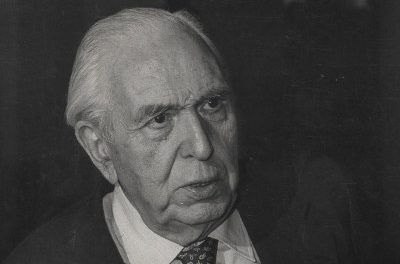
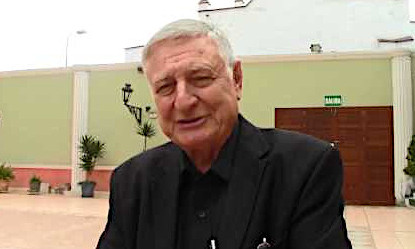
Ernesto Kahan, Nobel Peace Prize laureate representing the International Physicians for the Prevention of Nuclear War, Director of the World Organization of Writers and an Honorary Member of the Royal European Academy of Doctors (READ), shares with the academic community the article “In the Shelter, Waiting for the Future,” in which he recounts his own experiences in an air-raid shelter as a consequence of the war between Israel and Iran. Kahan also shared the article “Proposal for the Future of Humanity”, in which he advocates the implementation of a utopia consisting of the abolition of money and the creation of a secular religion. The academic is one of the promoters of the World Peace Forum, the organization with which the READ partnered to organise the World Peace Forum Barcelona 2023 together with the University of Barcelona, the Barcelona City Council, the Red Cross, the Catalonia Culture Foundation, Foment del Treball and the Reial Cercle Artístic de Barcelona.
In the Shelter, Waiting for the Future
I write these lines from a shelter in Israel. This is not a metaphor. It is not a literary device. It is the physical place where I am right now, sitting next to neighbours who a few minutes ago were running down the stairs while sirens sounded announcing missiles launched from Iran.
The sound of the alarm has something impossible to describe until one experiences it. It is not just noise: it is a biological command. The body moves before thought. Pick up the phone, look for those who are nearby, close the reinforced door, mentally count the children, the friends, the elderly.
Down here there are no political speeches. There are restrained breaths. A girl asks how long it will be before we can go back home. No one knows what to answer. A man tries to keep reading the news even though his hands tremble slightly. A woman distributes water as if that gesture could restore some sense of normality to the world.
From the outside, wars often appear to be strategic debates or ideological confrontations. From the inside—from civilian life—war is something else: it is the brutal interruption of routine, the permanent awareness of fragility. This text does not seek to speak on behalf of governments or armies. It is simply the point of view of my everyday life in Israel.
War Seen by Those Who Do Not Shoot
Most of the people sheltering here with me today do not participate in military or political decisions. They are ordinary citizens: doctors, teachers, students, immigrants who arrived seeking safety, families who built their homes here.
Yet we are all involuntary participants in the conflict. Each missile directed toward a city reminds us that behind the words war or geopolitics there are millions of civilians trying to live normal lives. Fear is not abstract. It has schedules, sounds and emotional consequences. It changes the way we sleep, how we plan the following day, even how we imagine the future. And yet something surprising happens: life insists.
Someone tells a joke. Another shares food. A child manages to laugh. In the midst of danger, civil society demonstrates a quiet resilience that rarely appears in international headlines.
Between Fear and Hope
Living under constant threat produces moral exhaustion. Not only fear, but a deeper question: how long?
Many citizens of the Middle East—Israelis, Iranians, Palestinians, Lebanese and other peoples—do not wish for endless wars or leaderships based on religious fanaticism or the destruction of the other. Most aspire to something simple and revolutionary at the same time: to live in peace. From this shelter it becomes evident that political or religious extremisms ultimately harm first the civilian populations they claim to represent.
Societies deserve leaders who build coexistence, not perpetual enemies. History shows that no region is eternally condemned to conflict. Europe also experienced devastating wars before choosing cooperation and tolerance as the basis of its future. Perhaps the Middle East is approaching a similar moment.
Imagining the Day After
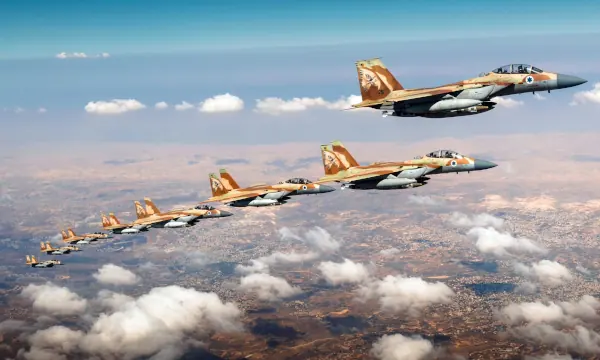
Israeli Air Force fighter jets en route to attack Iran, June 2025 / IDF Spokesperson’s Unit
While we wait for the alert to pass, I think that every war raises a collective moral decision.
Will we continue accepting endless cycles of violence? Or will this suffering finally open space for a new Middle East, more tolerant, where religious and cultural diversity is not a threat but a shared richness?
A peaceful future will require that regimes that feed hatred, terror and fanaticism lose influence to civil societies that demand dignity, development and coexistence.
The peoples of the region were not born to live in shelters. They were born to build open cities, full universities, lively markets and conversations between neighbours who do not fear one another.
When the Door Opens
The siren stops. For a few seconds no one moves. Then someone slowly opens the door. We return to the surface with the caution of those who do not yet know whether the danger has ended. Leaving the shelter never feels like a military victory. It feels like another opportunity to keep living.
I write this from Israel, from my personal experience, with fear but also with hope.
Because even here, underground, among alarms and missiles, a deep conviction persists: the future of the Middle East cannot be built on permanent fear, but on tolerance, mutual respect and the right of all peoples to live in peace.
And perhaps—when this war ends—we will remember these days as the moment when civil societies began to demand, with a voice impossible to ignore, a new beginning for the region.