

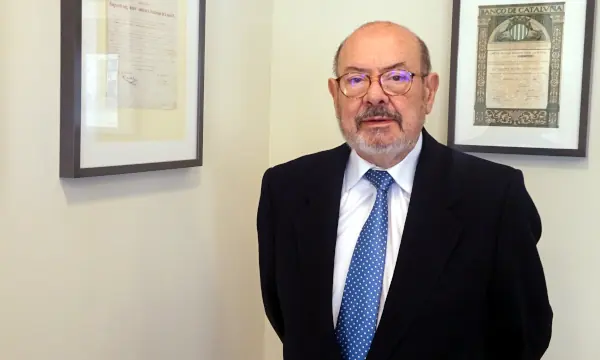
Dr. August Corominas
August Corominas, Professor of Human Physiology at the University of Murcia and the Autonomous University of Barcelona, and Emeritus Member of the Royal European Academy of Doctors (READ), shares with the academic community the article “Humanization,” in which he reflects on the human condition and the social role that has enabled the species to progress thanks to consciousness and moral awareness.
The academic has recently contributed to this publication with articles including “The Secret of Longevity in the ‘Blue Zones’,” “Beware of Falls, Day and Night,” “The Good Life and the Good Living,” “Biological Life and Quantum Life,” “Smart Hospitals,” “Cosmonautics and Space Medicine,” “Mistreatment and Its Management,” “Quantum Biology,” “The Black Man of Banyoles (Bushman or Hottentot),” “Polydactyly,” “Adolescence, the Critical Stage of Human Life,” “Mermaids, Illusion of Sailors and Seafarers,” “Biblical Nutrition: Clean and Unclean Foods,” “Rare Diseases,” “The Starving in Gaza,” “Sexology in Adolescence and Somatopause (Andropause and Menopause),” “Cyberattacks, Cyberwarfare and Cybersecurity,” “Refugees,” “Human Evil,” “Geostrategy of Rare Earths,” “Conscience and Omission: The Misery of the Ruler,” and “Plasticosis.” He is also the author of one of the chapters in the book “Vitality in Aging. If You Wish, You Can Live More Years in Good Health,” published by the Royal Corporation with the support of Vichy Catalan.
Humanization
I would like to invite you to reflect on a topic that concerns us all: humanity. Not merely as a species, but as a moral condition — as the capacity to think, feel, and act.
Since ancient times, philosophers such as Aristotle maintained that the human being is a rational animal, capable of living in society and seeking the common good. Centuries later, Immanuel Kant argued that every person possesses dignity and must be treated as an end in themselves, never merely as a means. These ideas remind us that humanity is not simply about existing, but about acting with conscience and ethics.
 Yet when we examine history, we see a constant duality. On the one hand, humanity has achieved extraordinary advances: scientific discoveries, technological development, medical breakthroughs that have saved millions of lives. We have been able to organize ourselves globally, as in the creation of the United Nations after one of the darkest periods of the twentieth century, in pursuit of peace and cooperation among nations.
On the other hand, we are also responsible for wars, inequality, discrimination, and environmental crises. The same ingenuity that allowed us to progress has been used to destroy. The technology that connects the world can also divide it. This raises a profound question: are we truly progressing as humanity, or are we advancing materially while regressing morally?
Humanity now stands at a decisive crossroads. Never before have we possessed so much knowledge, so much information, so much power. Yet power demands responsibility. To be human does not merely mean to think; it means to choose — to choose between indifference and solidarity, between selfishness and empathy.
The true measure of humanity is not found in the tallest buildings or the most advanced devices, but in our capacity for compassion — in how we treat the most vulnerable, how we respond to injustice, and how we care for the planet we share.
Perhaps the question is not whether humanity is inherently good or bad. Perhaps the real question is: what kind of humanity do we wish to build? Each generation faces the challenge of answering this through its actions.
Today more than ever, we need to recover fundamental values: respect, dialogue, responsibility, and empathy. The future is not predetermined. We write it every day through our decisions.
In conclusion, humanity is a blend of greatness and fragility. We are capable of creating beauty, science, and hope, but also of committing profound errors. The challenge is not to deny our flaws, but to learn from them. Not to cease advancing, but to advance with conscience.
To be human is not merely to belong to a species. It is to assume the commitment to make the world a more just, more supportive, and more dignified place for all.