


Dr. August Corominas
August Corominas, Professor of Human Physiology at the University of Murcia and the Autonomous University of Barcelona, and Emeritus Member of the Royal European Academy of Doctors (READ), shares with the academic community the article “Plasticosis”, in which he presents a new reality marked by the omnipresence of a material that has shaped human evolution since the twentieth century and now represents one of the major challenges for the environment.
The academic has recently shared in this publication the articles “The Secret of Longevity in the ‘Blue Zones’”, “Beware of Falls, by Night and by Day”, “The Good Life and the Life Well Lived”, “Biological Life and Quantum Life”, “Smart Hospitals”, “Cosmonautics and Space Medicine”, “Abuse and Its Management”, “Quantum Biology”, “The Black Man of Banyoles (Bushman or Hottentot)”, “Polydactyly”, “Adolescence: A Critical Stage of Human Life”, “Mermaids: Sailors’ Illusions and Men of the Sea”, “Biblical Diet: Pure and Impure Foods”, “Rare Diseases”, “The Famished in Gaza”, “Sexology from Adolescence to Somatopause (Andropause and Menopause)”, “Cyberattacks, Cyberwarfare and Cybersecurity”, “Refugees”, “Human Evil”, and “Conscience and Omission: The Misery of the Ruler”. He is also the author of one of the chapters in the book “Vitality in Aging: If You Wish, You Can Live More Years in Good Health”, published by the Academy with the support of Vichy Catalan.
Plasticosis
Plasticosis is an emerging term used to describe a disease or pathological condition caused by the accumulation of microplastics and nanoplastics in the tissues of living beings, especially marine animals and birds, although it is also a growing concern in humans.
1) What are plastics?
Plastics are synthetic materials made primarily from petroleum-derived polymers (although some may be partially biobased). They consist of long molecular chains that provide great versatility, but also high environmental durability.
Types of plastics (by chemical composition). Among the most common are:
- Polyethylene (PE): bags, packaging, etc.
- Polypropylene (PP): caps, technical textiles, etc.
- Polystyrene (PS): rigid containers, foam, lids.
- Polyvinyl chloride (PVC): pipes, coatings.
- PET (polyethylene terephthalate): bottles, textile fibers.
- Others such as polyesters, polyurethanes, and nylon.
These polymers are the ones most frequently fragmented into small particles in the environment.
2) What are microplastics and nanoplastics?
By size:
- Microplastics (MPs): solid particles from 0.1 µm up to 5 mm.
- Nanoplastics (NPs): even smaller particles, from 0.001 to 0.1 µm (1 to 100 nm).
Microplastics and nanoplastics are formed in two ways:
- Primary: deliberately manufactured at that size (microbeads in cosmetics, industrial pellets).
- Secondary: fragmentation of larger plastic waste due to sunlight, wind, and abrasion.
3) What is plasticosis?
The term plasticosis is sometimes used in media and studies to describe chronic pollution caused by plastics, particularly microplastics and nanoplastics that accumulate in organisms and ecosystems, producing adverse effects. It is not a standardized technical term, but rather a way of referring to the widespread phenomenon of plastic pollution. This problem includes:
- The presence of plastics in water, air, soil, and food.
- Integration into the food chain.
- Potential biological damage due to penetration into tissues.
4) How much plastic is there in the biosphere?
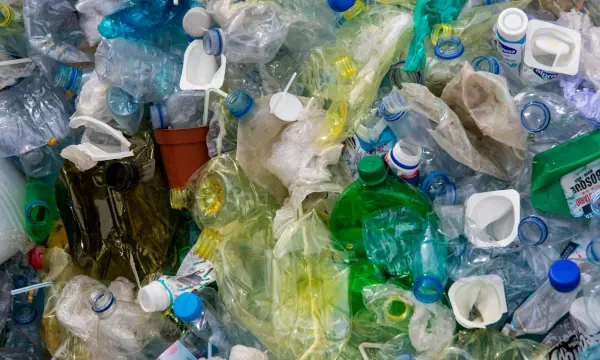
Foto de Magda Ehlers en Pexels
Although it is difficult to accurately measure all the plastic in the biosphere (the set of all the planet’s ecosystems), global estimates are extremely high. Each year, more than 400 million tons of plastic are produced worldwide. Only around 9% is recycled, while the rest ends up in landfills, incineration, or the environment. Plastic takes decades to thousands of years to degrade, leading to accumulation.
The oceans contain billions of microplastics, with estimates such as 51 trillion particles floating on the surface. In deep areas such as the Mariana Trench, up to 13,500 microplastics per cubic meter of water have been reported.
Under “business as usual” growth scenarios (with no significant reduction in waste), plastic debris entering ecosystems could double or triple in the coming decades.
5) Why do microplastics and nanoplastics matter?
Small plastic particles can enter the tissues and cells of animals and humans, be ingested by marine organisms and accumulate along the food chain, and, according to some studies, even be present in human organs and biological fluids.
Quick summary:
- Plastics: widely used, highly durable materials that are difficult to degrade.
- Microplastics: particles from 0.1 µm to 5 mm.
- Nanoplastics: particles smaller than 0.1 µm.
- Plasticosis: a general concept referring to persistent plastic pollution.
- The biosphere is saturated with plastic, and levels will continue to rise unless production and waste-management models change.