


Francisco González de Posada, Professor of Physical Foundations at the Polytechnic University of Madrid and Honorary Member of the Royal European Academy of Doctors (READ), and Jaume Llopis, Emeritus Professor at IESE Business School and Numerary Member and Vice-President of the Governing Board of the READ, participated on 20 and 21 November in an extraordinary session of the Telematic Classroom of the Academy of Sciences, Engineering and Humanities of Lanzarote dedicated to the series «Reflections on Today’s World»>, in which renowned experts analyse current geopolitical events from different perspectives.
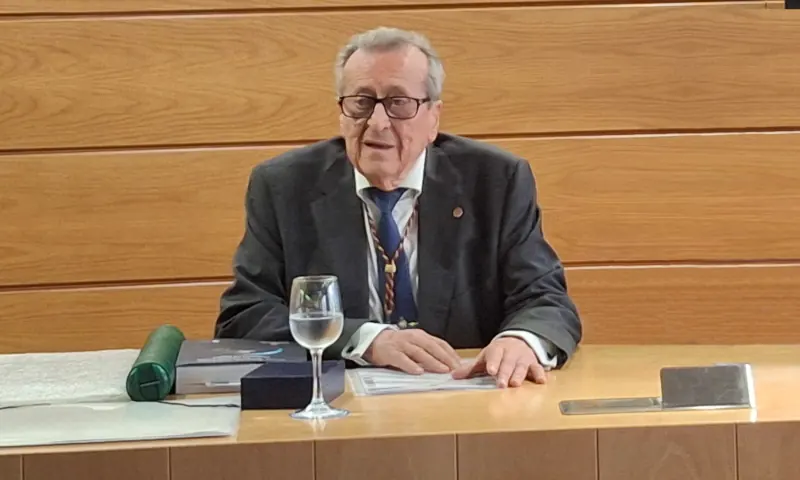
Dr Francisco González de Posada
As in previous sessions, González de Posada addressed the religious perspective, while Llopis focused on the economic perspective. They were joined by Manuel Medina, Professor of International Law and International Relations and former MP and former MEP, who analysed the geopolitical perspective; Lieutenant General Juan Antonio Carrasco of the Spanish Air and Space Force, former Chief of the Joint Defence Staff, who addressed the military perspective; Juan Jesús González Torres, agronomist and businessman, who examined the ethical perspective; and José Luis González de Rivera Revuelta, Professor of Psychiatry and Medical Psychology, who was in charge of the psychological-psychiatric perspective.
As President of the Academy of Lanzarote, González de Posada also acted as moderator of the sessions and presented the way in which religion has historically divided the Western world. Not only among religions with their own traditions, but also through the schisms that Christianity has experienced at the heart of Europe and the rejection of religion by reason brought about by the Enlightenment in the 18th century. This movement installed the separation of Church and State, relegating religion in the West to the private sphere—unlike what happens in other parts of today’s globalised world. He concluded by discussing the renewal of Christianity that took place in the 20th century with the Second Vatican Council. Despite its continuous crises throughout the centuries, González de Posada highlighted the resurgence of religion today, driven by conservative movements defending tradition.
For his part, Llopis presented an economic outlook characterised by a period of limited growth, in which the global economy shows signs of low or moderate expansion. Moreover, this growth is uneven, with clear differences between regions and between emerging economies and advanced ones. In this regard, the expert noted that fiscal policies, geopolitical tensions, lower external demand, and oil price volatility are among the factors influencing these disparities.
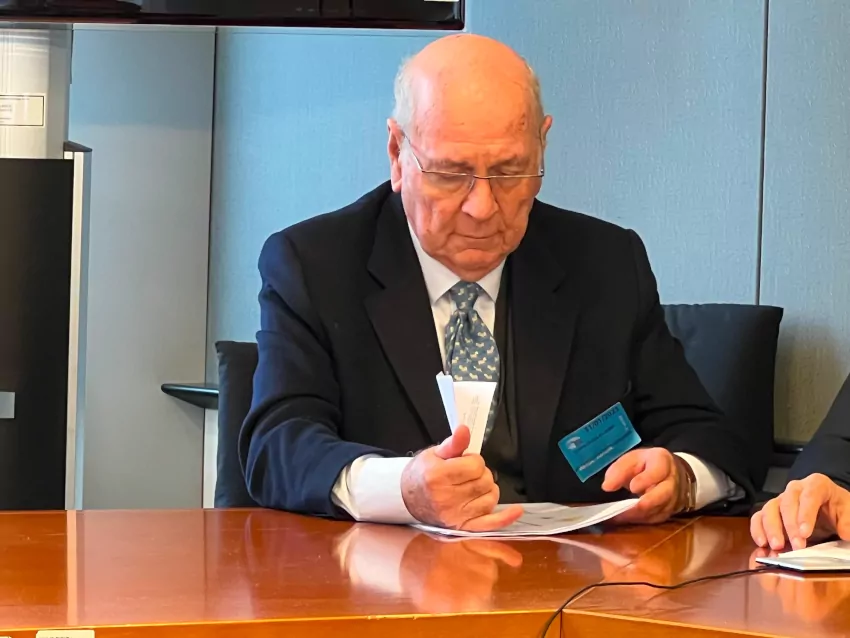
Dr Jaume Llopis
Llopis warned of the risks posed to global economic stability by the current tariff war launched by the Trump Administration, high public debt, reduced consumption, and disorderly financial corrections, with increasingly frequent sudden market crashes. To address this situation, the academic proposed fostering more solid, balanced and sustainable economic growth, redefining redistribution mechanisms, and adopting a new approach to wealth. He also emphasised the significant role that artificial intelligence will play as a disruptive technology in the economy.
González de Posada is a Numerary Member of the Royal National Academy of Medicine of Spain, the Royal Academy of Doctors of Spain and a member of the World Academy of Art and Science. He is a Corresponding Member of the Royal Academy of Fine Arts of Cádiz, the Royal Academy of Fine Arts of San Fernando, and the Royal Academy of Sciences, Fine Arts and Letters of Écija; and an Honorary Member of the Academy of Medical Sciences of Cantabria, the Royal Academy of Valencian Culture, the Royal Academy of Medicine and Surgery of Cádiz, and the Royal Academy of Medicine of the Canary Islands. He also serves as President of the Academy of Sciences, Engineering and Humanities of Lanzarote. Rocafort is Councillor of the Catalan Association of Accounting and Management, member of the Governing Board of the Fundación Independiente, Numerary Member of the Royal Academy of Economic and Financial Sciences and Numerary Member of the Academy of Diplomacy of the Kingdom of Spain.
Llopis, meanwhile, has had a long and successful career in business management in companies such as Moulinex, Nestlé, La Unión y el Fénix Español and Borges International Group. His extensive academic background includes his long-standing teaching role at IESE and his work as visiting professor at business schools such as IPADE (Mexico), AESE (Portugal), IDE (Ecuador), INCAE (Nicaragua), IEEM (Uruguay), MDE (Ivory Coast), the Instituto San Telmo in Seville, and EADA in Barcelona. He is the author of influential books in the field of business management.