


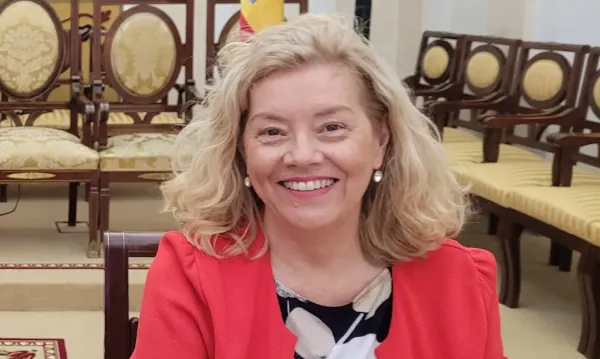
Dr Marcela González-Gross
Marcela González-Gross, Professor of Nutrition and Exercise Physiology and Director of the Department of Health and Human Performance at the Faculty of Physical Activity and Sport Sciences of the Technical University of Madrid, President of the Spanish Nutrition Society, Corresponding Member of the Royal National Academy of Pharmacy, and Full Member of the Royal European Academy of Doctors (READ), is part of the scientific group leading the Global Alliance for the Promotion of Physical Activity. This initiative brings together non-governmental organizations, scientific and professional societies, and sports associations in response to growing concern over the increasing prevalence of physical inactivity and non-communicable diseases worldwide.
The Alliance was founded at the 2021 Summit on Sport, Medicine and Health held in the German city of Hamburg under the leadership of the European Initiative “Exercise is Medicine,” whose Executive Board includes the academic. It is supported by organizations as diverse as the International Olympic Committee, the American College of Sports Medicine, the City of Hamburg, and numerous scientific, professional, and patient associations worldwide, with a total of 139 affiliated entities. The initiative follows the mandate of the so-called “Hamburg Declaration,” approved at that summit and ratified at subsequent summits in 2023 and 2025. This ongoing process calls on national and international legislators to develop concrete measures to combat sedentary lifestyles, promote daily physical activity and exercise at the population level, and integrate them into national health systems. The “Hamburg Declaration” remains an open framework, welcoming new organizations that wish to join.
In June 2025, its promoters took a further step by establishing the Framework of the Global Alliance for the Promotion of Physical Activity, introducing a novel and specific approach reflected in the Precision Prevention for Health protocol. In this document, experts urge public health systems worldwide to shift their policies toward disease prevention rather than waiting for diseases to emerge before treating them. To achieve this, they stress the importance of ensuring that policymakers move from theory to practice, placing population health at the forefront of public priorities. González-Gross was among the scientists who participated in drafting this expanded framework, incorporating precision prevention as a key innovation.

To raise awareness and promote the Alliance, the academic also participated on 29 September in the International Congress “Human in Motion,” held in Portorož, Slovenia, organized by the Institute for Kinesiology Research under the direction of renowned biomechanist Rado Pišot. During the event, she met with Slovenia’s Minister of Higher Education, Science and Innovation, Igor Papič, as well as officials from the country’s European Projects Office. They agreed on the need to increase resources for research projects, simplify procedures, address the current excessive competitiveness in funding, and continue strengthening high-quality European research. They also emphasized the importance of knowledge transfer so that public health messages and healthy lifestyle recommendations reach the entire population, helping Europe become a benchmark in precision prevention in public health.
According to the experts driving the Global Alliance for the Promotion of Physical Activity, physical inactivity ranks among the five leading causes of morbidity and mortality worldwide. Despite considerable efforts over the past 20 years, implemented measures have not achieved the expected effectiveness. Alarming projections indicate that by 2035, depending on the country, between 31% and 43% of adults in Europe are expected to be obese, while in countries such as the United States, Saudi Arabia, and Turkey, this percentage could exceed 55%. Of these, around 60% are projected to present comorbidities, including non-alcoholic fatty liver disease and an increase in mental health disorders, with depression and dementia among the most prevalent.
González-Gross is also a member of the executive boards of the Federation of European Nutrition Societies and the European “Exercise is Medicine” Initiative, a member of the International Union of Nutritional Sciences, a founding member of the scientific network Exernet, and a member of the CIBER Network on Obesity and Nutrition. She has participated in more than 70 research projects and delivered over 250 lectures nationally and internationally. Among several distinctions, she has received the National Award for Research in Sports Medicine granted by the University of Oviedo.