


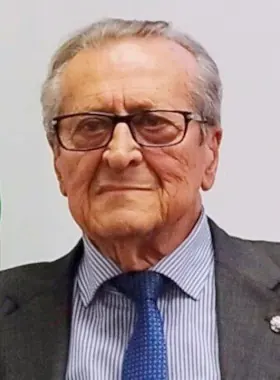
Dr. Francisco González de Posada
Francisco González de Posada, Professor of Physical Foundations at the Polytechnic University of Madrid and honorary member of the Royal European Academy of Doctors (READ), led on 2 March the Telematic Classroom session of the Academy of Sciences, Engineering and Humanities of Lanzarote, which he himself chairs, “The Universe of Contemporary Cosmology.” The expert presented an informative overview of the universe, addressing its origin, structure and evolution from an accessible scientific perspective. Director of the cosmology course held every August in Laredo במסגרת the University of Cantabria Summer Courses, González de Posada has delivered numerous lectures on the subject and has taken part in various series presenting the latest theories formulated about the origin, dimensions and perception of the cosmos thanks, among other contributions, to the observations of the new James Webb Telescope and advances in quantum physics studies from a multidisciplinary approach.
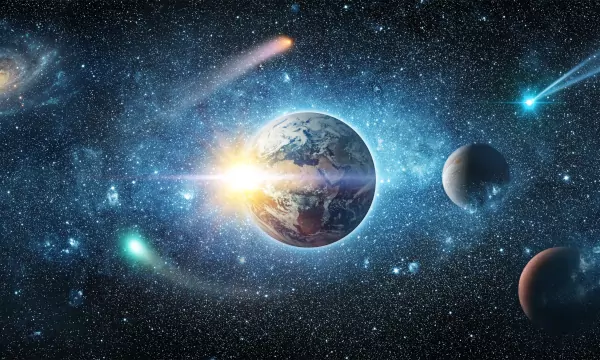
The speaker began at the beginning of the cosmos, the Big Bang, a great expansion that took place approximately 13.8 billion years ago, in order to point out how observations make it possible to determine that, since then, space has continued to expand, giving rise to the formation of galaxies, stars and planetary systems. From there he described the organisation of the cosmos, highlighting structures such as galaxies and their systems, such as the Solar System, where the Earth is located. At this point he underscored the immensity of the universe and the difficulty of comprehending its dimensions. The lecture also addressed key concepts such as gravity, the formation of stars and the possibility that many other habitable worlds may exist, although there is still no clear evidence of any of them.
 The professor reviewed the great conceptual revolutions of the 20th century: the fusion of space and time in the four-dimensional spacetime of Hermann Minkowski and Albert Einstein, the equivalence between matter and energy embodied in the equation E=mc², and the combination of deterministic and probabilistic laws governing the quantum world. He insisted that the Universe constitutes a single, autonomous and self-sufficient whole, endowed with spatiality, temporality, materiality and intrinsic dynamism, without requiring external entities or a creator for its scientific explanation. González de Posada also stressed the epistemological limits of current physics: it is not possible to know what existed before the Big Bang or to speculate rigorously about parallel universes or universes beyond our observable one. “We know that we cannot know anything outside our universe,” he stated. Finally, he acknowledged that major enigmas remain unresolved, among them the exact nature of dark matter and dark energy, components necessary to explain observations but still undetectable directly.
González de Posada is an engineer and holds a doctorate in Civil Engineering from the Polytechnic University of Madrid, a degree in Philosophy and Letters from the Pontifical University of Salamanca and a degree in Physical Sciences from the Complutense University of Madrid. He was awarded the Medal of Honour for the Promotion of Invention and also served as Rector of the University of Cantabria. He is a full member of the Royal Academy of Doctors of Spain and a member of the World Academy of Art and Science, a corresponding member of the Royal Academy of Fine Arts of Cádiz, the Royal Academy of Fine Arts of San Fernando and the Royal Academy of Sciences, Fine Arts and Humanities of Écija, and an honorary member of the Academy of Medical Sciences of Cantabria, the Royal Academy of Valencian Culture, the Royal Academy of Medicine and Surgery of Cádiz and the Royal Academy of Medicine of the Canary Islands.