

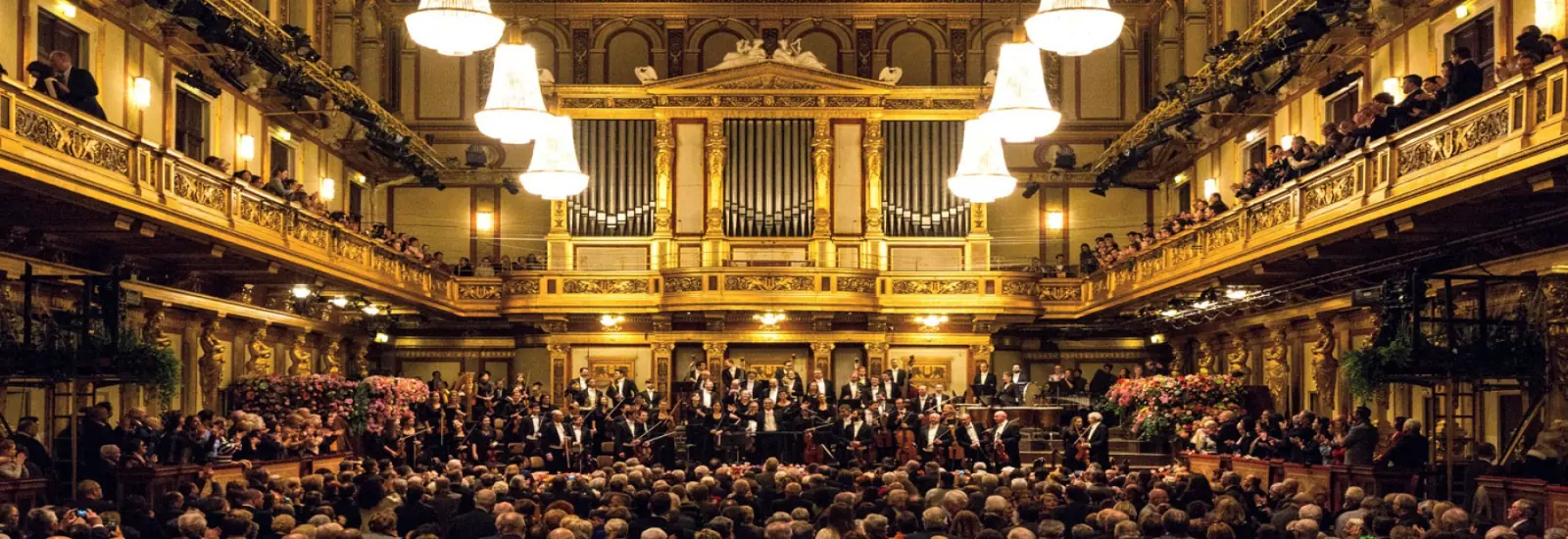
A delegation from the Royal European Academy of Doctors (READ) had the privilege of attending, on December 31, one of the legendary New Year’s concerts held by the Vienna Philharmonic in the Golden Hall of the Musikverein in the Austrian capital. The select event, organized by the Royal Academy, was attended by full academicians Montserrat Casanovas, Paula Plaza, Albert Bosch, José María Simón Castellví, Fernando Pedro Méndez, and Josep Maria Bové, joined by elected corresponding academician Víctor Canivell. They were accompanied by their closest family members.
Over four days, from December 28 to January 1, participants in this unique event enjoyed private guided tours of Vienna’s most emblematic landmarks, such as the State Opera, Schönbrunn Palace, the Hundertwasser Houses, and the Belvedere Museum, included in itineraries through Imperial Vienna and Modernist Vienna. They also had the opportunity to take a route along the Danube River and ascend Mount Kahlenberg, with lunch at a landmark restaurant. Members of the delegation also took part in the walking tour «Vienna, Emperors and Musicians» and enjoyed an exclusive visit to St. Stephen’s Cathedral and the Austrian National Library. In addition, they were able to visit the popular Christmas markets that were still open, as well as enjoy lunches and dinners at selected restaurants, including the New Year’s Eve gala dinner, which crowned a truly unique day.
Considered the most popular classical music concert in the world, this edition of the Vienna New Year’s Concert was conducted by Canadian maestro Yannick Nézet-Séguin, who included in the program two works composed by women: the «Rainbow Waltz» by Florence Price and «Sirens’ Songs» by Josephine Weinlich. These were not the only premieres heard in the iconic auditorium, where the orchestra also performed three other pieces that had never before been included in this event. After the traditional encore of «The Blue Danube», Nézet-Séguin stepped down from the podium to conduct the much-anticipated «Radetzky March», which traditionally brings the concert to a close among the audience.