


Daniel Berzosa, Professor of Constitutional Law and Fundamental Rights at CUNEF University, the Institute of Stock Exchange Studies, and IE Law & Business School; member of the Global Academy and the Scientific Council of the international collective Citizens pro Europe; and Full Member and member of the Governing Board of the Royal European Academy of Doctors (READ), reflects on the implications for the British parliamentary monarchy of the prosecution of Andrew Mountbatten, brother of King Charles III, in connection with the Epstein case. His analysis appears in the article “Andrew Windsor and the Rule of Law,” published on 20 February in the newspaper ABC.
“The arrest of Andrew Mountbatten-Windsor, until recently Prince Andrew of England, at his Sandringham residence has marked a milestone in the contemporary history of the United Kingdom. The English police have confirmed, with a delicacy departing from their usual practice, the arrest of ‘a man in his sixties from Norfolk’ on suspicion of ‘misconduct in public office,’ within the framework of an investigation that has gained momentum following the publication of documents linked to Jeffrey Epstein. As a jurist, I must emphasize that arrest does not equate to guilt. In the British criminal system, as in any democracy worthy of the name, the presumption of innocence applies with equal force to an ordinary citizen and to a former member of the royal family. The charges may entail custodial sentences, but only after a fair trial with full guarantees can criminal responsibility be established. Nevertheless, what has occurred requires going beyond a prudent legal warning, as it involves a reputational crisis that transcends the individual,” the academic begins.
For Berzosa, the arrest of a member of the reigning family should not be interpreted as a challenge to the monarchy, but rather as a reaffirmation of equality before the law, while firmly upholding the presumption of innocence. He recalls that King Charles III had previously stripped his brother of titles, honors, and official duties in order to protect the integrity of the Crown and prevent personal conduct from damaging institutional credibility. These exceptional measures were aimed at preserving public trust and demonstrating that the monarchy stands not above the law. In this regard, Berzosa reiterates that the legitimacy of the institution depends on its submission to the Constitution, transparency, and exemplary conduct.
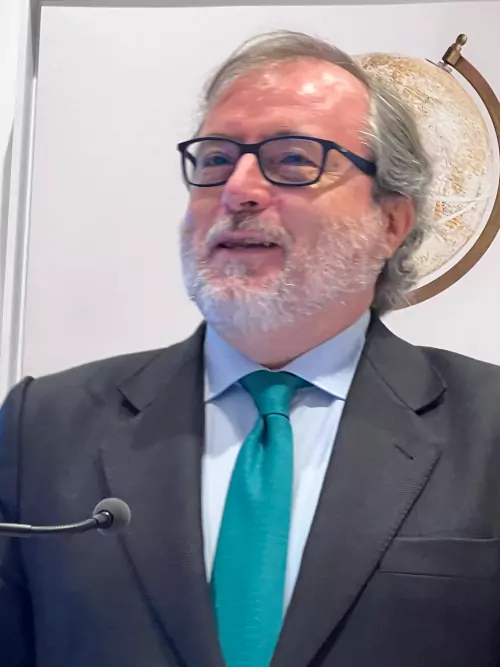
Dr. Daniel Berzosa
The jurist draws a parallel with the Urdangarin case in Spain, which similarly underscored the need for accountability and ethical renewal within the monarchy. He concludes that the strength of the Crown in modern democracies lies in its respect for the law and in the confidence it inspires among citizens. “With the arrest of Andrew Mountbatten-Windsor, the rule of law has spoken firmly. Institutional reputation will now be decided, as always, in the realm of justice, truth, and public perception. For in advanced democracies, the Crown retains its meaning only when it is subject to the Constitution and the law — and, above all, when the public believes it,” he concludes.
Berzosa is a member of the U.S. Society of Diplomacy and Political Sciences, coordinator of the International Observatory on the Regulation of Public Sector Entities at the University of Santiago de Compostela, member of the organizing committees of the World Law Congress (Cartagena de Indias 2021 and Madrid 2019), and author of books and scholarly articles published in prestigious journals. He is also a recognized commentator on legal and political science issues in major Spanish media outlets.