


Javier Junceda, a renowned jurist, former Dean of the Faculty of Law at the International University of Catalonia, and elected Full Member of the Royal European Academy of Doctors (READ), is the creator and driving force behind the new Hispano-American Legal Studies Forum, a platform for dialogue and debate among Spanish and Latin American jurists on current issues affecting the legal profession. Its meetings will be held in a hybrid format, both virtually and in person, with the latter taking place at Junceda’s law firm offices. The founding faculty includes distinguished jurists Carlos Balbín, Professor of Administrative Law at the University of Buenos Aires and administrative court judge, and Jorge Danós, Professor of Administrative Law at the Pontifical Catholic University of Peru and practicing lawyer, widely regarded as leading authorities in administrative law in Argentina and Peru, respectively. They will be joined by prominent Peruvian jurists Mario Castillo and Francisco Miró-Quesada, Mexican jurist José María López Padilla, and American jurist Anthony Rionda, together with Junceda himself. The group is currently working on incorporating distinguished legal professionals from Chile and Paraguay.
The new Forum held its first meeting on 29 January in a virtual format, with the participation of Balbín, Danós, and Junceda, along with numerous registered attendees connecting from Spain, Argentina, Peru, Mexico, and the United States. In addition to presenting the initiative, the three jurists announced an ambitious academic program addressing different areas of law from a Hispano-American perspective. As reported by the newspaper “La Nueva España” and the specialized portal Law & Trends, Junceda focused his intervention on the unstable international context, capable of reshaping Spanish and European policies such as those related to decarbonization and the energy transition due to foreseeable defense-related budgetary demands. He also emphasized the need for digitalization aimed at achieving greater administrative simplification. “In addition to conferences and specialized programs delivered by leading experts, we will also offer cycles and monographic courses on specific subjects, all developed with a strongly theoretical and practical approach,” noted the elected academician.
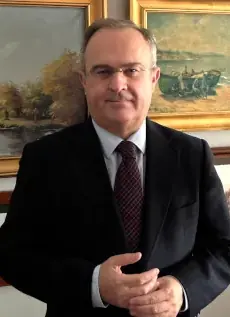
Dr Javier Junceda
Founder and Director of Junceda Abogados, the elected academician is a Full Member of the Royal Institute of Asturian Studies, where he chairs the Commission on Law, Social Sciences, and Economics; a Full Member of the Asturian Royal Academy of Jurisprudence; a Corresponding Member of the Royal Academy of Jurisprudence and Legislation of Spain and of the North American Academy of the Spanish Language; and an Honorary Member of the Peruvian Academy of Law. He is also a member of the Barcelona Arbitration Court, the Arbitration Court of the European Arbitration Association, based in Madrid, and the Arbitration Court of the Pontifical Catholic University of Peru. Since 2016, he has served as a member of the Urban Planning and Territorial Organization Commission of the Principality of Asturias, appointed among experts of recognized prestige, and as a member of the Advisory Council of the Spanish Association of Urban Planning Law.
He has participated as an expert in 18 parliamentary committees on legislative reforms and has drafted numerous legislative proposals, bills, and regulatory provisions. He is the author or co-author of more than two hundred legal works, some of which have served as references in judicial rulings by the Constitutional Court of Chile, the Supreme Court of Peru, and courts in Bolivia. He has received distinctions in the Luis Sela Sampil Awards for doctrinal articles at the Faculty of Law of the University of Oviedo, as well as on two occasions in the prestigious Financial Studies Award (1992 and 2012), organized by the Center for Financial Studies of Madrid. He is also a member of the editorial boards of fourteen Spanish and international legal journals. He has been awarded honorary doctorates by six foreign universities and has served as honorary professor at six others. Throughout his career, he has acted as director, lecturer, or professor in more than fifty training programs conducted in Spain and across Ibero-America.