

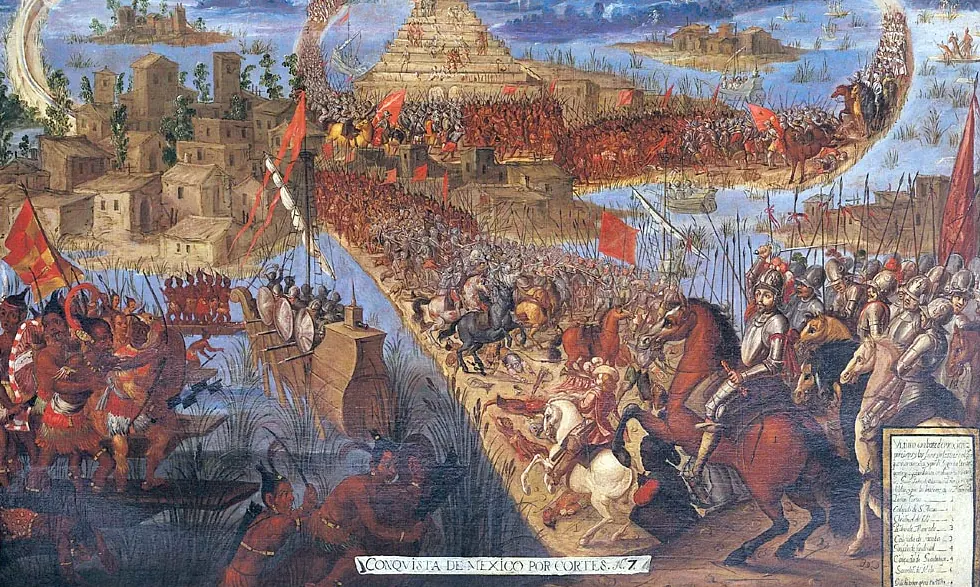
The Conquest of Tenochtitlan (Conquest of México series), domini públic, vía Picryl
Mexican historian Enrique Sada, a regular contributor to the Royal European Academy of Doctors (READ), shares with the academic community his articles “Maciel y Netflix: Cortina de humo,” “Octubre, mes de la Hispanidad,” and “¿Otra vez perdón a España?”, published between October 10 and November 1 on the digital platform Código Libre and in the newspaper El Siglo de Torreón, in which he addresses various issues in Mexican current affairs and their historical connections.
Sada also participated as a speaker in the first edition of the International Congress “Foundation of Cities and Settlement Processes in New Spain: Sources, Methodologies, Actors and Spaces,” organized by the Refugio Reyes Chair of the Autonomous University of Zacatecas and held on November 12 in this Mexican city, capital of the state of Zacatecas. The expert took part in the session “Commercial Dimension: Camino Real de Tierra Adentro” with the paper “Along the Royal Road: The Case of San Joseph y Santiago del Álamo de Parras (17th–18th Centuries).”
In “Maciel y Netflix: Cortina de humo,” the historian refers to the television series produced by the American streaming platform about the controversial figure Marcial Maciel, asserting that it lacks historical rigor. “This year Netflix released a documentary more sensationalist than informative, titled ‘Maciel. El lobo de Dios.’ Instead of reviewing serious documentary sources or citing Vatican Archive records—such as the one showing that the heroic Pope Pius XII was about to dissolve the Legionaries of Christ before his death—they rely on what has already been said or on people ignorant of historical-religious matters, such as Carmen Aristegui, without contributing anything new to what everyone already knows about this sociopath,” he explains.
In “Octubre, mes de la Hispanidad,” Sada reflects on the political and partisan interpretations made around Christopher Columbus’s discovery of America more than five centuries ago. “Few moments in the history of humanity involve events, intersections of lives and destinies, of such magnitude that they completely transform not only the world around us but our entire conception of it as we know it. The discovery of America, in a sense, laid to rest everything that had been accepted as unique and absolute from Antiquity until the very moment of what some scholars have rightly called the first globalization, as it has been described over the last decade,” he writes.

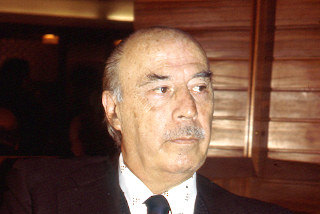
Enrique Sada
Finally, in “¿Otra vez perdón a España?”, the READ collaborator addresses the Spanish discovery and conquest of America in relation to the recent apologies expressed by Spain’s Minister of Foreign Affairs, José Manuel Albares, and the reactions of other historians, such as Juan Miguel Zunzunegui, in the digital newspaper El Debate: “Imagine this: Hernán Cortés arrives with 400 men, and with 400 men he takes Tenochtitlan. That is ridiculous! Especially if they tell you that Tenochtitlan was the great capital of a powerful empire. Thinking that such an empire would fall to 400 people is absurd. The reality is that the city fell to more than 99,000 warriors who were Indigenous—tlaxcaltecas, cholutecas, chichimecas, chalcas, totonacas—all of them allies of Hernán Cortés,” Sada recounts, echoing this reaction.
Regarding the International Congress of Zacatecas, the academic gathering focused on the founding of Guadalajara and Villa Celaya, the mission routes in northwestern Sonora, and the Valladolid intendancy of Michoacán, among other aspects of the formation of New Spain in what is now northern Mexico. Particular importance was given to the case of Zacatecas and the founding of municipalities such as Pinos, Saín Alto, Pánuco, the capital, Hacienda Nueva, Chupaderos and La Pila, belonging to Morelos, Nieves and the Caxcán town of Mecatabasco. The congress also addressed the rise of haciendas de beneficio (silver-processing estates) and the settlements that emerged around mining activities, as highlighted by the organizers.