

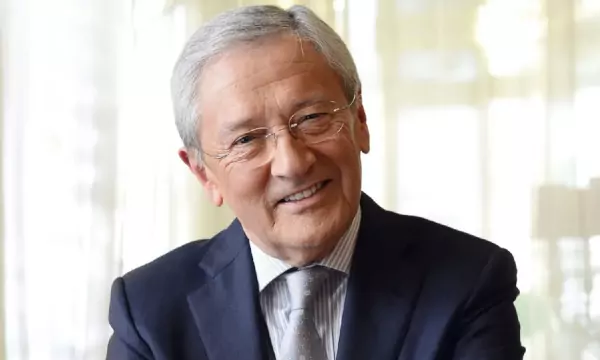
Sr. Fernando Ónega
Fernando Ónega, renowned journalist, president of the senior-affairs platform 65ymás and Honorary Academician of the Royal European Academy of Doctors (READ), has been featured in several reports across newspapers and digital outlets following his appearance on the television program “Plano General”, broadcast on La 2 and hosted by Jenaro Castro, on November 9. During the interview, the Academician revealed that his current wife, Ángela Rodrigo, with whom he has been married for 25 years, saved his life by donating a kidney. Ónega also shared with his interviewer various aspects of his personal life and spoke about his three children: Cristina and Sonsoles, from his relationship with Marisol Salcedo, and Fernando.
In the digital newspaper El Español, journalist Alina Varela recalls the moment when the veteran journalist opened up on camera. “Ónega analyzed political and social current affairs and even revisited some of the most sensitive moments of his life. One of those moments occurred in 2021, when he underwent a kidney transplant. At that time, he received an organ donated by his wife, Ángela Rodrigo. ‘My wife offered herself from the very first moment,’ he recalled. ‘I could say millions of good things about my wife. What hurts me the most—and will hurt me all my life—is that I have been through every operating room in Madrid,’ he explained while speaking of his second wife, whom he married in 2000.”
Similarly, in La Razón, journalist Marian Benito highlights the deeply emotional television moment. “It was something that moved him profoundly, and he still cries when remembering it, because of his wife’s generosity: ‘There was disagreement. My arteries were a mess from smoking so much. So there were doubts about whether I should undergo the transplant. And my wife offered herself from the very first moment, and she gave it to me.’ And he added: ‘I cry less now, but I have cried, because you truly have to be incredibly generous to do something like that,’” the journalist notes before sharing further details from the interview.
La Vanguardia also focuses on Ónega’s revelation during his conversation with Castro. “‘My wife offered herself from the very first moment,’ confessed Ónega, visibly moved, who also explained that his arteries were severely damaged after years of smoking, which raised medical doubts about the viability of the transplant. The journalist recalled the moment he awoke after the operation and saw his wife in the bed next to him: ‘Are you there?’ was the first thing he asked. He admits he has cried many times recounting it. ‘You have to be very brave and very generous to do something like that,’ he said about his partner,” the Barcelona daily reports.
Finally, in Mujer Hoy, journalist Juanra López also centers his article on the same episode, while highlighting the figure of Ángela Rodrigo and noting that one of the rare public photos of the couple was taken during Ónega’s induction into the READ. “Always discreet about his private life, Fernando Ónega met his second wife in 2000, meaning they have already celebrated their silver wedding anniversary. Despite the journalist’s great public visibility—having collaborated on programs such as ‘Saber vivir’ with Manuel Torreiglesias or ‘El programa de Ana Rosa’ with Ana Rosa Quintana—very few personal details have ever come to light. There are barely any photographs of the couple. That is why the moment on March 13 was so relevant, when Fernando Ónega was recognized as an Honorary Academician by the Royal European Academy of Doctors (READ) at the Paraninfo of the Complutense University of Madrid. There, avoiding the spotlight as much as possible, was Ángela Rodrigo, though a family photo was eventually taken, showing the excellent relationship among them all,” the magazine explains.
A former Press Secretary to the President of the Spanish Government under Adolfo Suárez, and author of many of Suárez’s speeches, Ónega has worked across numerous print and broadcast media. On radio, he pioneered the political commentary genre during Spain’s democratic transition on the program “Hora 25” on Cadena SER. He later served as News Director for both Cadena SER and Cadena COPE, and as Director General of Onda Cero, where he collaborated with Luis del Olmo and Carlos Herrera. In print media, he published his first article at age 13 in La Noche (Santiago de Compostela). Two years later, he was already signing a weekly page and conducting interviews for El Progreso (Lugo). He directed the newspaper Ya, founded the confidential service and agency Off the Record, and is currently a columnist for La Vanguardia and La Voz de Galicia. On television, he directed several programs on Televisión Española, served as Director of External Relations for the public broadcaster, and presented news programs on Telecinco and Antena 3. He is also the author of several books, including El termómetro de la vida, Puedo prometer y prometo, Juan Carlos I, and Qué nos ha pasado, España. Over the course of his career, he has received more than one hundred awards.