



Dr Teresa Freixes
Teresa Freixes, Jean Monnet ad personam Professor, President of the international organization Citizens pro Europe, Vice President of the civic platform Sociedad Civil Catalana, and Numerary Member and Vice President of the Governing Board of the Royal European Academy of Doctors (READ), reflects on current Spanish and international political affairs in the articles «Totalitarianism, Autocracy and Populism», «The CJEU and Constitutional Courts», «The King’s Address», «Extremadura Has Spoken», and «Fireworks or a Link in the Demolition», published throughout December on the specialist portal Artículo 14 and the digital newspaper The Objective. In addition, during the same month Freixes directed the European Charles V Prize Doctoral Seminar for Pluridisciplinary Studies on Contemporary Europe – European Disability Forum, held at the Royal Monastery of Santa María de Guadalupe under the title «United in Diversity: The Impact of the European Union on the Lives of Persons with Disabilities». The seminar brought together researchers from Spain, Germany, Belgium, France, Serbia, and Colombia.
In «Totalitarianism, Autocracy and Populism», the READ Vice President argues that the government of Pedro Sánchez has distorted Spanish democracy by forcing institutions and undermining the separation of powers. «Labeling the situation as totalitarian may seem alarmist or ill-intentioned if one does not delve into its meaning when applied to what is happening in Spain today. Yet the grotesque decomposition of the Sánchez regime—clear to anyone minimally informed—is not perceived by its loyal followers, who also perpetuate a false narrative aimed above all at preventing anyone other than themselves from governing Spain. They have moved from colonizing institutions to inducing social lethargy, propped up by doses of illiberal populism, defending a form of totalitarianism that has invaded not only the political sphere but also the social and economic realms. They are close to falling definitively from grace, as they are already doing so in fragments due to scandals involving corruption and abuse, but what is still lacking is the trigger that will allow us to move toward democratic renewal», she writes.
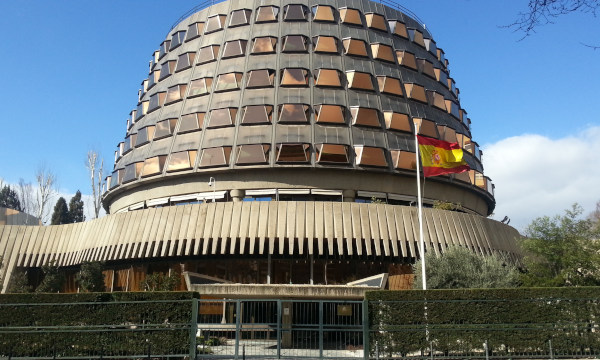
In «The CJEU and Constitutional Courts», Freixes highlights the role of European justice as a guarantor of the rule of law in Member States. «Europe—the European Union—is placing ever greater importance on rule-of-law guarantees as a core EU value. It no longer responds solely to preliminary questions raised by domestic judges; European institutions themselves now ensure compliance with indicators established both by the EU and by the Venice Commission. Pending issues include the appointment of four members of the Constitutional Court and the reform of the Organic Law of the Judiciary to adapt the General Council of the Judiciary to European standards, as agreed in the structured dialogue between the European Commission, the PSOE and the PP, with the commitment that this matter should be resolved as soon as possible. More than a year has passed, and we are still waiting, despite the Venice Commission having taken a clear stance, demanding adaptation and setting concrete criteria on certain points, with no favorable signs of compliance on the horizon,» she explains.
In «The King’s Address», the academic analyzes the Christmas speech delivered by Felipe VI. «The rejection of attacks on the Constitution, the rule of law, and the values of the Transition underlies the King’s defense of everything that unites us in the face of extremism, radicalism, and populism, while lamenting the loss of trust in politics brought about by growing polarization, which erects walls and perpetuates—if not creates—resentments. He delivered this message from the Royal Palace, standing for the first time, precisely from the Hall of Columns where Spain’s accession to the then European Communities—now the European Union—was signed», she notes.
 In «Extremadura Has Spoken», Freixes turns to the recent snap elections held in this autonomous community, expressing her hope that a governance agreement can be reached without prejudice. «Let us hope that María Guardiola does not have to dissolve the Extremadura Assembly again, as she stated during the campaign should she fail to achieve her governance objectives. In other contexts, in other countries, respect for the election winner—whoever it may be—entails facilitating government formation. In such a scenario, the second most-voted party would lead collaborative options by offering either a governing coalition, parliamentary support, or at least abstention to allow a government to form. The same rule could apply to the third party. With the numbers on the table, this is entirely possible in Extremadura, since the PP holds more seats than the entire left combined», she argues.
Finally, in «Fireworks or a Link in the Demolition», the President of Citizens pro Europe reflects on the fragility of Pedro Sánchez’s executive. «How much longer will this situation last? Sánchez claims it is worth governing—being in government, we should say—despite everything that is happening. For him, it surely is worth it, because stepping down would mean the end of much of the institutional occupation carried out by his allies. With that, the possibility of interfering in economic and judicial matters would also disappear; if he cannot control them directly, he will continue crafting narratives—whether sufficient or not—to ensure that his ‘resistance manual’ remains in force until some as-yet-unknown trigger returns the floor to the citizenry. We do not know, therefore, whether what we are seeing now is mere fireworks and distraction, or whether it continues to correspond to what can be considered one of the stages of systematic demolition contained in his roadmap», she concludes.