

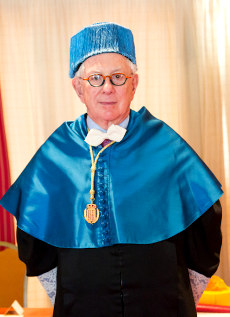
Honorary Academician
Experimental Sciences: Doctor in Physics
Date of admission: July 10, 2017
Nobel Prize in Physics 1979: Awarded the Nobel Prize for the Standard Model of elementary particle physics and the electroweak theory.
Dr. SHELDON GLASHOW
ACADEMIC ACTIVITY
- In 1960, he formulated a theoretical model that unified Maxwell’s electromagnetism with Fermi’s weak force, giving rise to the so-called electroweak interaction.
- He predicted the existence of the weak neutral current, a key concept in both theoretical and experimental physics.
- One of the fundamental predictions of his model was the existence of the Z boson, experimentally observed at the CERN in 1973.
- The universe is governed by four fundamental forces: gravity, electromagnetism, the weak interaction, and the strong interaction.
- Following the path initiated by James Clerk Maxwell in the 19th century by unifying electricity and magnetism, Glashow extended the unification principle to the electroweak forces.
- His theory demonstrated that, despite their differences in strength and range, electromagnetism and the weak force could be understood within the same conceptual framework.
AWARDS AND HONOURS
- Nobel Prize in Physics for the development of the electroweak theory, shared with Steven Weinberg and Abdus Salam.
- Considered one of the founding fathers of the Standard Model of Particle Physics.
- His work paved the way for experimental discoveries that transformed modern understanding of the universe’s fundamental structure.